
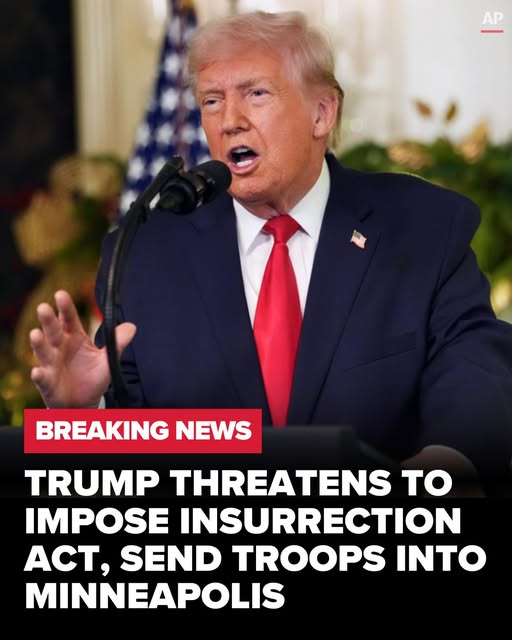
U.S. President Donald Trump has warned that he is prepared to invoke the Insurrection Act in order to “put an end” to escalating protests in Minneapolis. The statement immediately sent shockwaves through American politics, as the Insurrection Act is one of the most controversial federal laws, granting the president the authority to deploy the U.S. military within the country.
According to U.S. media reports, Trump’s remarks came amid several days of heightened unrest in Minneapolis, where protests have intensified and, in some cases, turned violent, with clashes reported between demonstrators and law enforcement. The White House has argued that local authorities have failed to maintain order, prompting the federal government to consider tougher measures to restore stability.
Originally enacted in the early 19th century, the Insurrection Act allows a president to deploy federal troops or federalize the National Guard in situations involving rebellion, widespread disorder, or when state governments are unable or unwilling to protect citizens’ constitutional rights. Historically, the law has been used sparingly due to its profound political, legal, and social consequences. Sending troops into American cities is widely seen as a last resort.
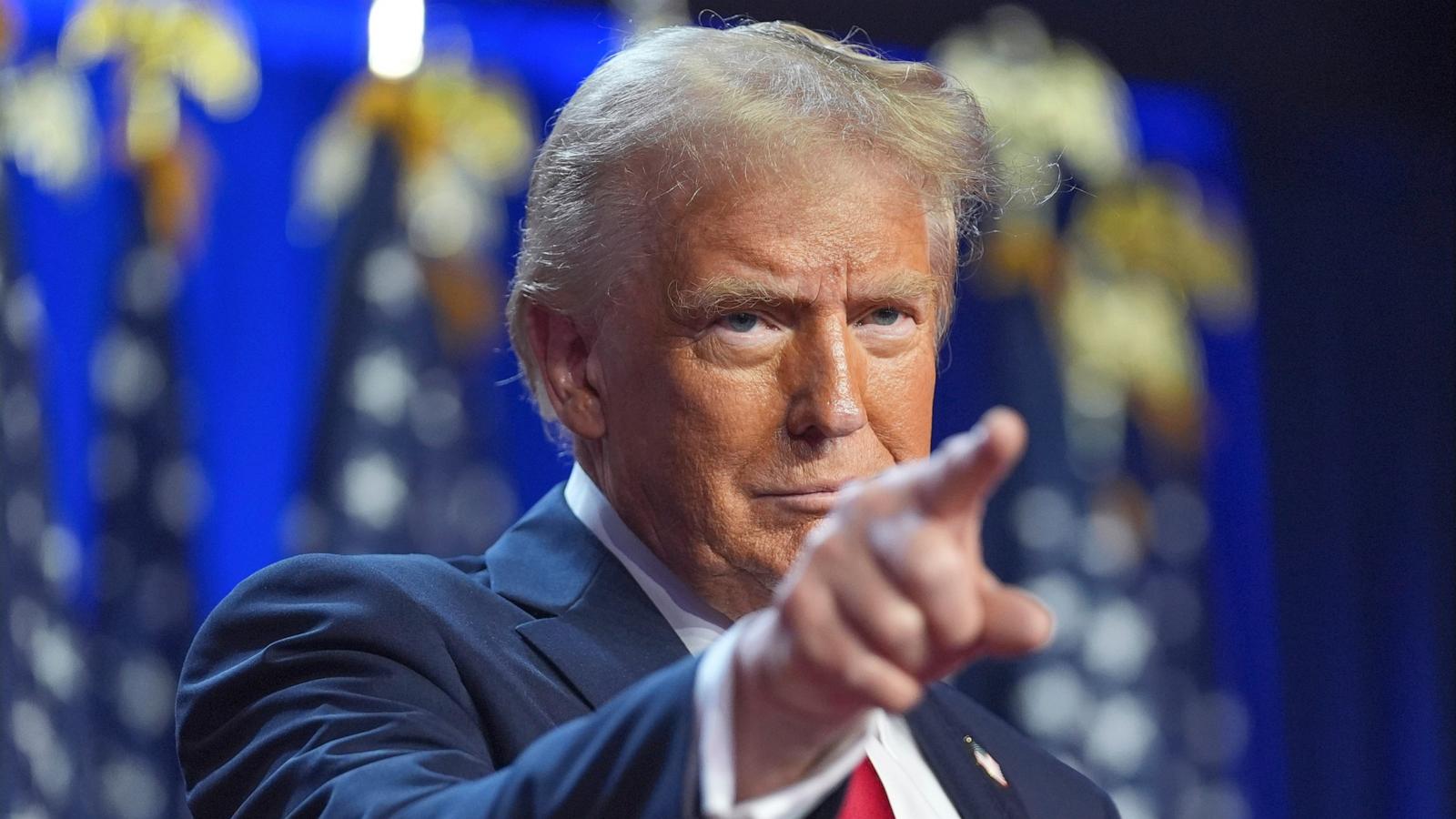
Trump’s threat has quickly ignited fierce debate across the political spectrum. Supporters argue that invoking the Insurrection Act would be a necessary deterrent against violence and looting, emphasizing the government’s responsibility to protect lives and property. From this perspective, when protests cross the line from peaceful demonstration into chaos, federal intervention becomes justified.
Critics, however, warn that using the Insurrection Act risks the militarization of civil unrest and could further inflame tensions. Civil rights organizations and opposition politicians have voiced concerns that soldiers trained for combat are not equipped to handle civilian crowd control. They fear that deploying troops could lead to excessive use of force, escalation, and irreversible damage to public trust.
Legal scholars have also weighed in, noting that while the president has broad discretion under the Insurrection Act, exercising that power would set a troubling precedent. If invoked too readily, the law could be abused in future political crises, weakening the authority of state governments and undermining civil liberties protected by the Constitution.

Politically, Trump’s statement is widely interpreted as a signal to his “law and order” base, reinforcing his image as a leader willing to take decisive action against unrest. At the same time, it places intense pressure on Minneapolis officials and the state of Minnesota to demonstrate control over the situation. However, the move also risks deepening divisions in an already polarized society grappling with issues of race, policing, and confidence in government institutions.
The possibility of invoking the Insurrection Act also raises broader questions about the balance of power between federal and state governments. Traditionally, public safety and policing fall under state and local jurisdiction. Federal intervention on this scale would mark a dramatic shift, potentially redefining how the U.S. responds to large-scale domestic unrest.
In the end, Trump’s threat to deploy troops to Minneapolis goes beyond a simple security warning. It represents a highly sensitive political and legal maneuver with far-reaching implications. Whether or not the Insurrection Act is ultimately invoked, the episode underscores the severity of the current crisis and highlights a fundamental debate in American democracy: where the line should be drawn between maintaining order and preserving civil freedoms.