
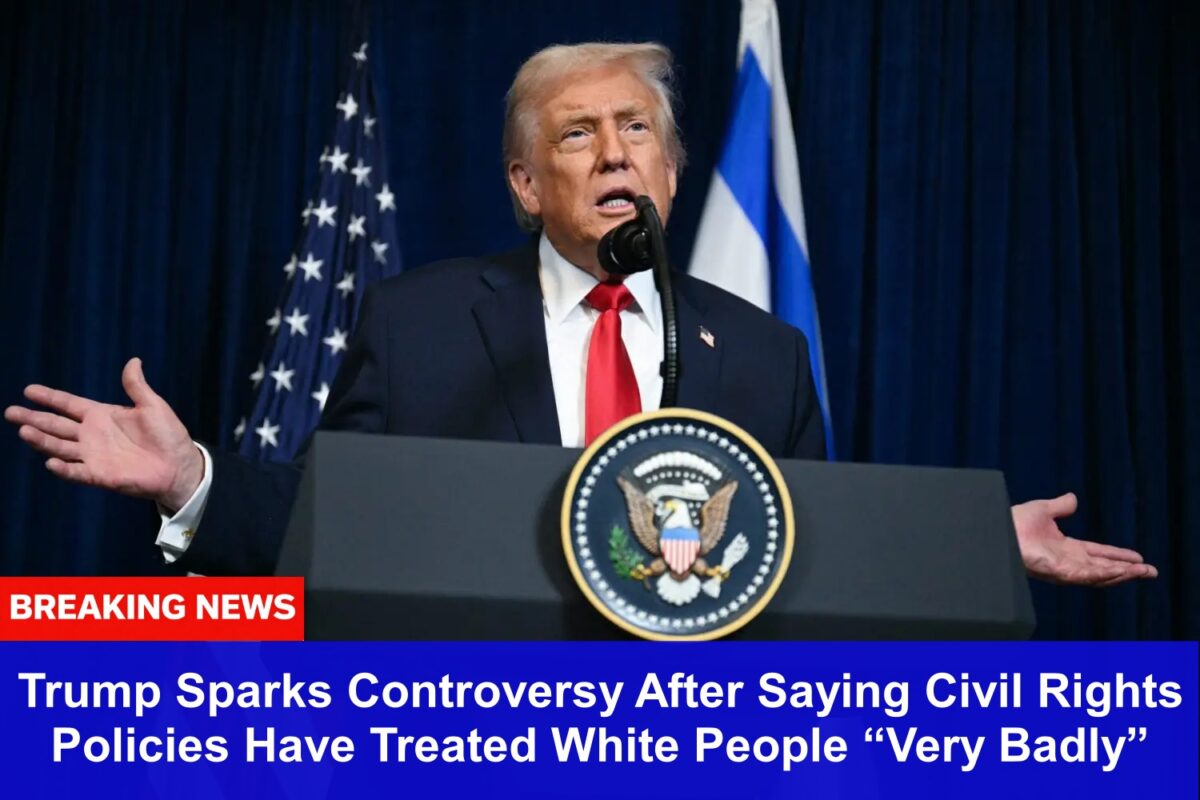
Recent remarks by Donald Trump have ignited widespread controversy across the United States, after he claimed that civil rights–era policies have resulted in white people being treated “very badly.” His comments have reignited a long-running national debate over race, equality, and the role of government policies in addressing historical discrimination.
Trump made the statement while discussing civil rights protections that were introduced during the mid-20th century to combat racial discrimination against minority groups. According to Trump, these policies—while originally intended to promote fairness—have evolved into systems that disadvantage white Americans, particularly in areas such as employment, education, and professional advancement.
He argued that many white individuals, especially white men, now face obstacles in hiring and promotion processes due to diversity-focused initiatives. In his view, merit-based evaluation has been increasingly replaced by race-conscious policies, which he claims undermine equal opportunity rather than protect it.

The comments quickly resonated with segments of conservative voters who have long criticized diversity, equity, and inclusion (DEI) programs. Supporters argue that such initiatives unfairly prioritize race over qualifications and contribute to social division. They see Trump’s remarks as a candid acknowledgment of grievances they believe are often dismissed or ignored in mainstream political discourse.
However, critics strongly rejected Trump’s claims, warning that his framing distorts the purpose and impact of civil rights legislation. Civil rights advocates, academics, and Democratic leaders emphasized that these laws were enacted to address systemic inequalities that persisted for generations, particularly against Black Americans and other minority communities.
Experts note that civil rights protections are not designed to guarantee equal outcomes, but rather to ensure equal access and opportunity. From this perspective, describing such policies as treating white people “very badly” risks oversimplifying complex social realities and inflaming racial tensions. Critics argue that Trump’s language may deepen divisions at a time when racial reconciliation and social cohesion remain fragile.
The controversy also highlights the broader political polarization surrounding race and identity in the United States. Issues such as affirmative action, workplace diversity, and educational admissions have become central battlegrounds in American politics, often framed along partisan lines.

For Trump’s supporters, his remarks reflect a willingness to challenge what they view as ideological orthodoxy and political correctness. For his opponents, the comments represent yet another example of rhetoric that, they say, undermines the legacy of the civil rights movement and marginalizes the experiences of historically disadvantaged groups.
Regardless of perspective, the reaction underscores how sensitive and deeply rooted debates over civil rights remain in American society. Statements from high-profile political figures continue to shape public discourse and influence how these policies are understood by the broader population.
As the United States approaches another highly charged political period, discussions surrounding race, fairness, and equality are likely to intensify. Trump’s remarks have once again placed civil rights policies at the center of national debate, raising questions about how the country defines justice, opportunity, and equality in the modern era.