
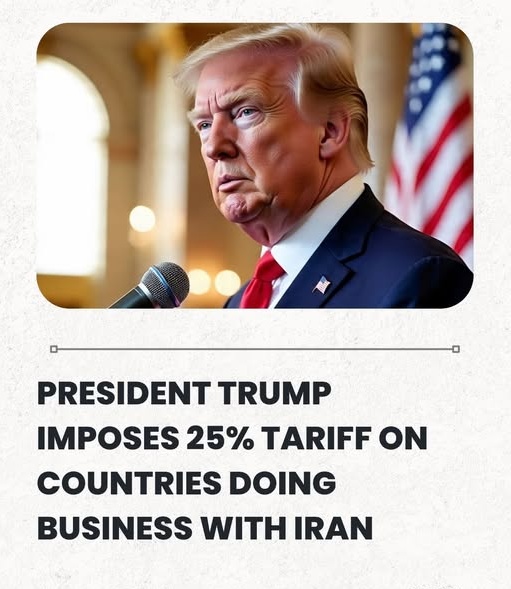
President Donald Trump on Monday announced that any country “doing business” with Iran will face a 25% tariff on all trade with the United States, marking a sharp escalation in international trade tensions. According to a statement posted by Trump on social media, the measure takes effect immediately and was described as “final and decisive.”
The announcement comes amid deep political unrest in Iran, including the largest anti-government protests the country has seen in decades, alongside Washington’s long-standing sanctions regime. The move is widely viewed as an effort to intensify economic pressure on Tehran while isolating its trading partners from access to the U.S. market.
In his statement, Trump said that “any nation that trades with the Islamic Republic of Iran will be required to pay a 25% tariff on all commercial dealings with the United States.” However, specific details regarding the scope, enforcement mechanisms, and legal basis of the tariff have not yet been fully clarified. As of now, no official executive order or supporting documentation has been publicly released by the administration.
Countries Potentially Affected
The decision could significantly impact several of Iran’s key trading partners, including China, India, Turkey, the United Arab Emirates, and Iraq, which are major buyers of Iranian oil and goods. China, currently Iran’s largest oil customer, responded critically to the announcement, warning that it would take “all necessary measures” to safeguard its legitimate economic interests.
China’s embassy in Washington strongly condemned the move, calling it an act of “unlawful unilateral coercion” and cautioning that “trade wars have no winners.” Beijing argued that such tariffs would damage global commerce and further destabilize already fragile international economic relations.
India, another major trading partner of Iran and a leading exporter of basmati rice to the country, could also face serious consequences. Indian exporters have already expressed concern that the new tariff could disrupt agricultural trade, particularly at a time when instability in Iran and broader tariff uncertainty are already affecting exports.
International Reaction
Beyond China, a number of other countries have voiced concern or are closely monitoring developments. Germany, Japan, and South Korea are reportedly assessing the potential impact on their own trade relationships and considering possible responses. For nations heavily dependent on access to the U.S. market, the new tariff policy presents a difficult dilemma between economic interests and diplomatic alignment.
Analysts see the move as part of a broader revival of Washington’s so-called “maximum pressure” strategy against Iran, which has included extensive sanctions and trade restrictions over many years. While existing U.S. laws already allow for sanctions against Iran, the newly announced tariff represents a broader approach by directly targeting third-party countries that maintain commercial ties with Tehran.
Long-Term Impact
Economic experts warn that the tariff decision could severely disrupt global trade, raise consumer prices, and place additional pressure on businesses operating across borders. There are also concerns about potential legal challenges, particularly regarding the scope of presidential authority to impose sweeping tariffs without explicit congressional approval.
The announcement comes as the U.S. Supreme Court is reportedly reviewing cases related to executive powers over trade and tariffs, raising the possibility that this policy could become a landmark issue in U.S. economic and constitutional law.
If implemented as stated, the 25% tariff could mark a significant turning point in U.S. trade policy, with far-reaching implications for international markets, diplomatic relations, and the global economic order.