
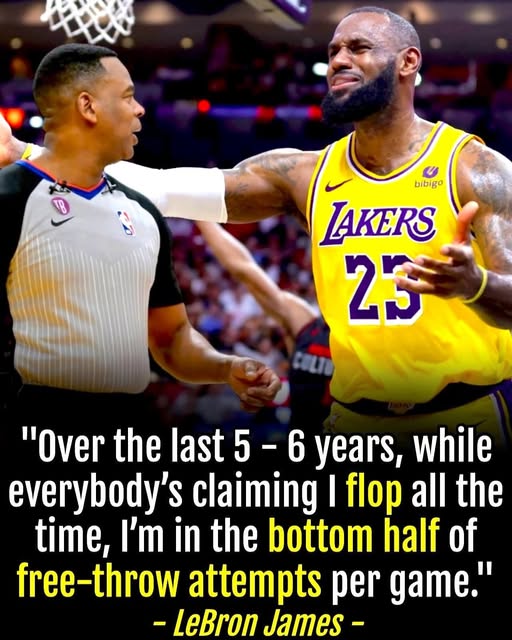
For many years, LeBron James has remained at the center of nonstop debate in the NBA. Beyond discussions about legacy and championships, one of the most persistent criticisms aimed at the Los Angeles Lakers superstar is the accusation of “flopping” — the idea that he exaggerates contact to draw fouls from referees. Recently, LeBron addressed those claims head-on, offering an argument that has reignited conversation across the basketball world: in reality, he does not get as many free throws as people assume.
According to LeBron, over the past five to six seasons, despite constantly being labeled a flopper, he has actually ranked in the bottom half of the NBA in free-throw attempts per game. This claim runs directly counter to the common perception of LeBron as a superstar who relentlessly attacks the rim and benefits from favorable officiating. For him, statistics tell a far more accurate story than public opinion.
LeBron also shared an interesting anecdote from inside the locker room. He recalled conversations with teammates who, before joining the Lakers, admitted they used to believe he got every call when they played against him — and that it frustrated them. Once they became his teammates, however, their perspective changed. “Now that we’re on the same team, I realize — wow, you actually don’t get many calls at all,” LeBron said, recounting their remarks. That contrast highlights the gap between perception and on-court reality.
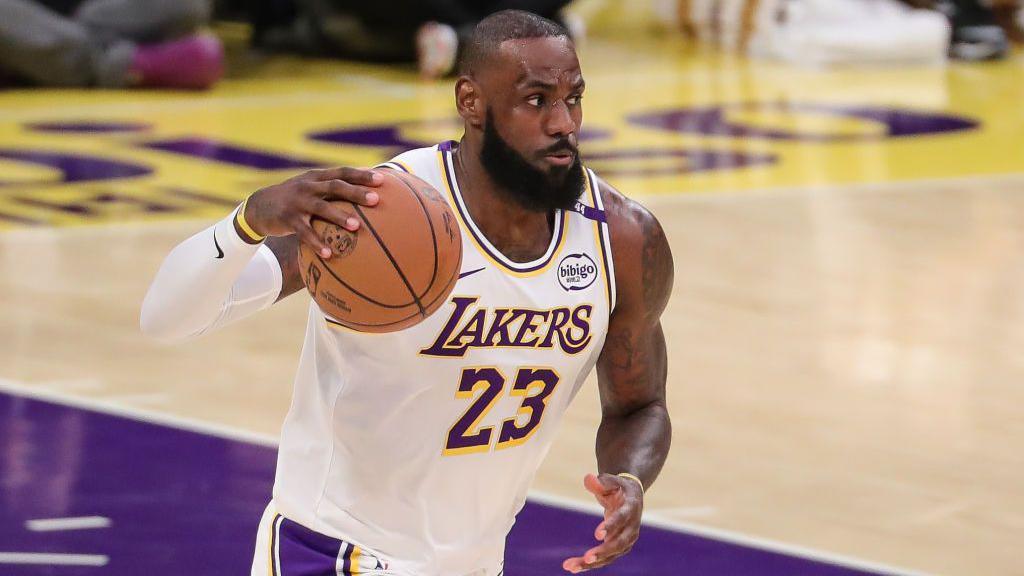
Of course, LeBron not leading the league in free-throw attempts does not automatically invalidate every criticism. Many of his plays involve high speed and immense physical force, making certain collisions appear more dramatic than usual. At the same time, his extraordinary size and strength often work against him. LeBron frequently absorbs contact without falling, which can result in no whistle on plays where smaller players might get a call. This paradox is familiar to physically dominant stars: they take more punishment, yet are not always rewarded with fouls.
Another factor is how LeBron’s playing style has evolved. Early in his career, he attacked the basket relentlessly, creating frequent foul situations. In recent seasons, as he has aged, LeBron has adapted — distributing the ball more, choosing his moments to drive, and conserving energy for defense and game management. This natural evolution has reduced the number of direct collisions, which in turn impacts his free-throw totals.

The flopping debate ultimately reflects a broader issue: how fans evaluate superstars. For players of LeBron’s stature, every fall is scrutinized and every whistle is magnified. When the team wins, calls are seen as favoritism; when it loses, the same calls become evidence of bias. In that environment, LeBron’s response serves not only as self-defense but also as a reminder that context and data should matter more than emotion.
In the end, this discussion underscores why LeBron James remains one of the most polarizing figures in NBA history. He is not only judged by his achievements, but also by the narratives surrounding how the game is officiated and interpreted. Whether fans agree with him or not, LeBron’s comments introduce a different perspective: sometimes the belief that a superstar is “favored” is more myth than fact, while the numbers reveal a far more nuanced reality.