
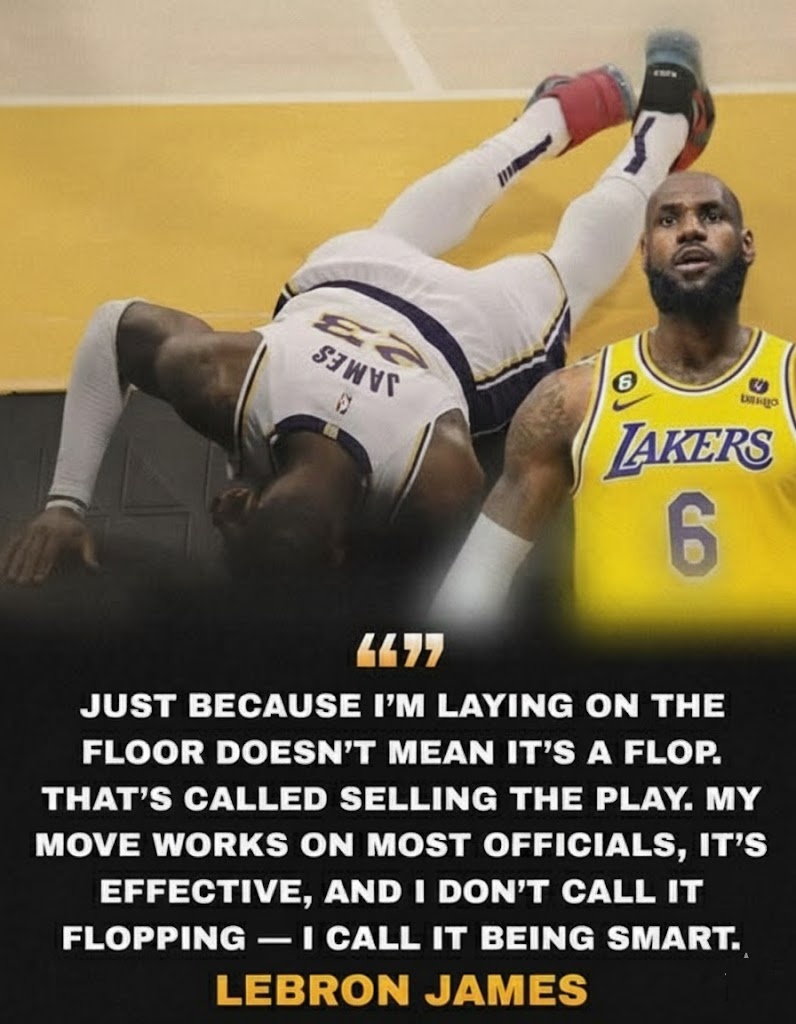
For many years, LeBron James has remained at the center of endless debates across the NBA. Beyond the familiar discussions about championships, records, and the GOAT conversation, another criticism has frequently followed the superstar: flopping—exaggerating contact to draw fouls from referees. In response to that criticism, LeBron recently addressed the issue head-on, offering a very different perspective on how he approaches the game.
“Just because I’m laying on the floor doesn’t mean it’s a flop. That’s called selling the play. It works on most officials. It’s effective. I don’t call it flopping—I call it being smart,” LeBron said. The comment immediately ignited heated debate among NBA fans, as it touched on the thin line between strategy and deception.
In modern basketball, the concept of “selling the play” is no longer unfamiliar. With the game played at such high speed and physical intensity, referees cannot always clearly see every collision. Strong reactions after contact are often viewed as a way to highlight a play, drawing the officials’ attention and influencing a call. From LeBron’s point of view, this is not deception, but simply part of the game—where experience and awareness can be just as important as raw talent.
Not everyone agrees. Critics argue that exaggerating contact hurts the integrity of the sport and makes the game less appealing. To them, flopping—no matter how it is rebranded as “selling the play”—is still an exploitation of loopholes in the rules. They believe it sets a poor example, especially for younger players who look up to stars like LeBron.
Supporters, however, see it differently. They point out that the NBA is an extremely competitive environment, where even the smallest advantage can decide the outcome of a game. When contact is real and the rules allow officials to judge fouls based on a player’s reaction, taking advantage of that reality is not cheating—it’s adaptation. From this perspective, LeBron is simply using the experience gained over more than two decades in the league to maximize opportunities for his team.
What stands out most is that LeBron does not deny that his actions are calculated. In fact, he openly acknowledges that the approach is “effective.” That honesty is what makes his statement so striking. Rather than avoiding controversy or presenting a morally polished image, LeBron chooses to confront the issue directly and define it as what he believes it is: a strategic choice.

The debate over flopping, therefore, goes beyond LeBron James himself. It reflects a broader reality of the modern NBA, where increased speed, physicality, and pressure have blurred the line between smart play and gamesmanship. And for a player as closely scrutinized as LeBron, every candid comment only deepens the divide among fans and analysts.
Whether one agrees or disagrees with his stance, LeBron James has undeniably reignited an important discussion: in elite basketball, do victories come purely from skill—or from the ability to read the game and “sell” key moments better than the opposition? That question is likely to remain controversial for years to come.