
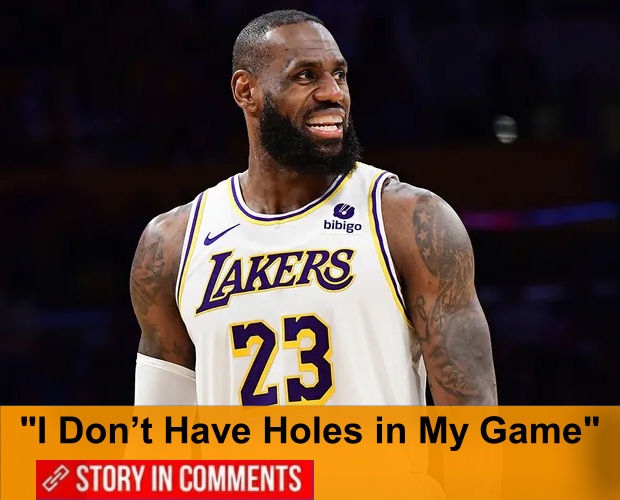
At a stage when many superstars have faded into the background or seen their influence diminish, LeBron James continues to stand firmly at the center of NBA conversations. Recently, the Los Angeles Lakers icon drew attention with a direct and confident declaration: “I don’t have holes in my game.” It was a short sentence, yet one that carried the weight of experience, self-belief, and the mentality of a player who has spent more than two decades at the highest level of professional basketball.
In recent seasons, LeBron has no longer been the player who dominates the ball on every possession. His usage rate has declined compared to his prime years, reflecting a shift in role within the Lakers’ offensive system. However, what has surprised many analysts is that his productivity has not declined in the same way. LeBron continues to score efficiently, create opportunities for teammates, and influence games with elite decision-making and court vision.
When LeBron says, “I don’t have holes in my game,” he is not merely talking about individual skills. He is referring to a complete basketball package: scoring at all three levels, elite passing, defensive awareness, and a deep understanding of game flow. Even as age inevitably reduces raw athletic explosiveness, LeBron compensates with basketball IQ, positioning, and timing—traits that separate great players from true legends.

One of the most impressive aspects of LeBron’s evolution is his adaptability. He understands that extending his career and maximizing team success no longer requires him to shoulder every offensive possession. By reducing his usage, LeBron conserves energy, chooses his moments more carefully, and empowers teammates to contribute. This adjustment does not diminish his importance; instead, it highlights his maturity and strategic mindset.
The quote featured in the image can also be interpreted as a subtle response to critics who argue that LeBron is past his prime. At an age when most players are long retired, he remains a tactical centerpiece, an emotional leader, and a competitive benchmark for the Lakers. His confidence is not rooted in reputation alone, but in consistent on-court impact and an ability to deliver in critical moments.
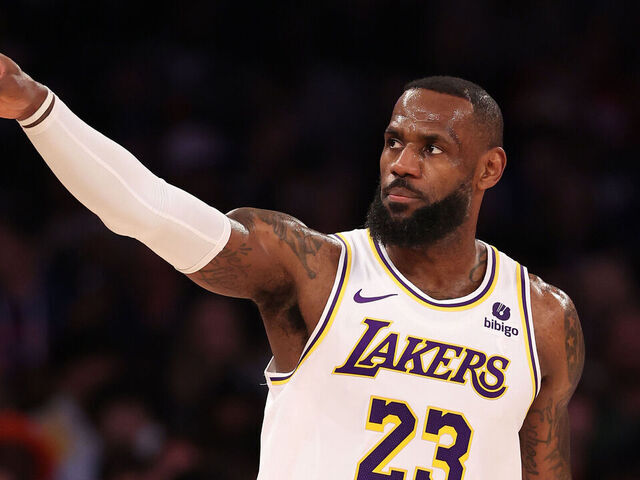
More importantly, LeBron’s statement reflects his philosophy at this stage of his career: versatility, intelligence, and efficiency. He no longer needs to prove dominance through volume. His value lies in being able to adapt to whatever the game demands—whether that means scoring, facilitating, defending, or guiding younger teammates through difficult stretches.
When the team needs points, LeBron can still take over. When the offense needs structure, he becomes the organizer. And when leadership is required, he remains the unquestioned voice in the locker room. This flexibility is precisely why he believes there are no weaknesses in his game.
“I don’t have holes in my game” is therefore more than a confident quote. It is a reminder from a generational talent that greatness is not defined by how often you control the ball, but by how effectively you shape the outcome of the game. Even as roles evolve and time moves forward, LeBron James’ core value on the basketball court remains firmly intact.