
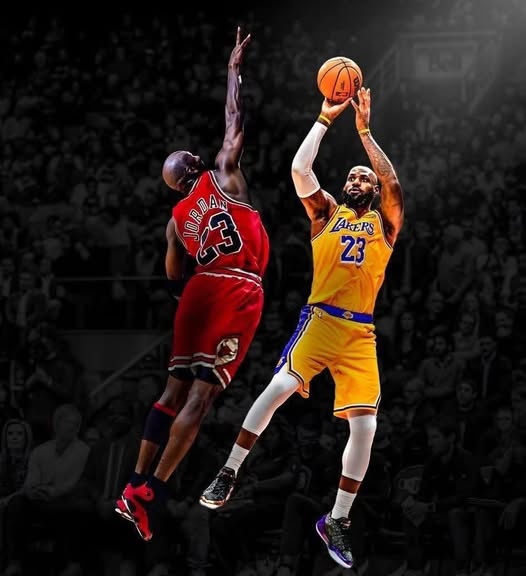
The GOAT debate between LeBron James and Michael Jordan never truly cools down, but it has flared up again following a striking statement from ESPN analyst James Gates. Rather than directly diminishing Michael Jordan’s greatness, Gates approached the comparison from a different angle: overall impact on a team. His conclusion was clear — when it comes to elevating an entire roster, LeBron James stands above Jordan.
According to Gates, Jordan represents cold-blooded dominance, killer instinct, and the ability to finish games in the biggest moments. However, when the discussion shifts to lifting an average or even weak team into true championship contention, LeBron is the superior choice. Gates’ comments quickly ignited intense debate across the NBA community, especially between die-hard Jordan and LeBron supporters.

James Gates explained his perspective with a blunt and widely shared comparison:
“If you have a good team and you need a ‘killer,’ you go MJ.
If you have a good team and you want that entire group to get better and go to the Finals together, you go LeBron.
MJ is not going to lift up a bad team; LeBron can.
Who would I rather have taking the last shot? MJ.
Who’s going to help your team get better? LeBron.”
This quote captures the core of Gates’ argument. He is not dismissing Jordan’s legacy, but rather placing both legends into distinct basketball roles. Jordan is the ideal weapon for a roster already built to win championships — a player who can take over, score relentlessly, and crush opponents when it matters most. LeBron, on the other hand, is seen as the system itself — the engine that makes everyone around him better through playmaking, court vision, and leadership.
NBA history offers support for this view. LeBron has repeatedly carried teams widely considered inferior into the NBA Finals, most notably during his years with the Cleveland Cavaliers. In those seasons, Cleveland often lacked depth and elite star power, yet LeBron carried the load by doing everything: scoring, facilitating, defending, and setting the emotional tone for the team.

Michael Jordan’s championships, by contrast, came with Chicago Bulls teams that were carefully constructed, well-coached, and balanced on both ends of the floor. This does not diminish Jordan’s greatness, but it reinforces the idea that team structure played a significant role in his success, something that fuels ongoing debate among analysts.
Gates’ comments also reflect a modern basketball mindset, where elevating teammates and maximizing collective performance is increasingly valued. In this context, LeBron James represents the prototype of the modern superstar — one who doesn’t just score, but transforms how an entire team functions.
Ultimately, the Jordan-versus-LeBron debate may never be settled. But as James Gates suggests, the real question isn’t who is greater in absolute terms — it’s what you need from your superstar. And when the goal is to elevate an entire team, LeBron James clearly holds the advantage.