
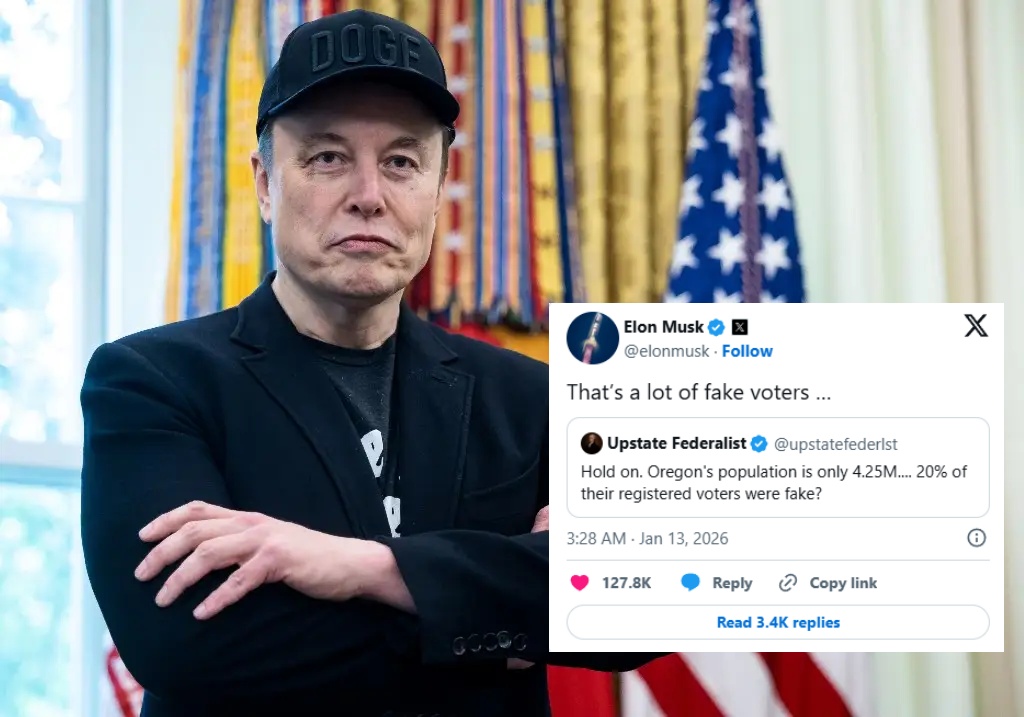
A series of posts on the social media platform X has reignited controversy over Oregon’s election system after Elon Musk suggested that the state has “a lot of fake voters.” The comment came after Musk reacted to a post arguing that Oregon’s population is just over 4.2 million while its voter registration numbers appear unusually high, leading to the conclusion that roughly 20% of registered voters were “fake.”
The claim spread rapidly online and generated hundreds of thousands of interactions. However, when examined in the context of Oregon’s actual election data and administrative practices, the assertion has been rejected for conflating two very different concepts: “inactive voters” and “fake voters.”
Under Oregon’s election system, hundreds of thousands of voter records are currently classified as inactive. These are individuals who previously registered to vote legitimately but later had outdated information, most commonly due to moving, changing personal details, or failing to respond to address verification notices from county election officials. In such cases, the records are not immediately deleted but are retained in the database with restricted status.

Crucially, inactive voters are not sent ballots. To vote again, they must update their address or provide new proof of eligibility. As a result, the presence of these names on the voter rolls does not mean they are voting, nor does it constitute evidence of election fraud.
Oregon currently has about 3 million active registered voters out of more than 3.4 million voting-age adults. The state’s relatively high registration rate is partly the result of automatic voter registration, which applies to residents who obtain or renew a driver’s license or state identification card. While this system expands access to voter registration, it also increases the number of records that require regular administrative updates.
The existence of a large number of inactive voters has been the subject of political debate for months. State officials have acknowledged that voter rolls need to be maintained more rigorously and that some outdated records should eventually be removed. Nevertheless, election administrators emphasize that this is an administrative issue, not an indication that Oregon’s elections are compromised or that “fake voters” are casting ballots.
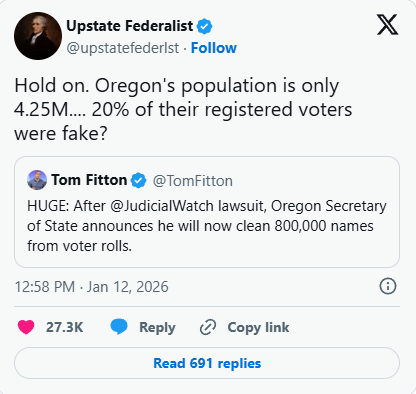
The controversy highlights how election data can be misinterpreted when stripped of its legal and technical context. Large raw numbers in a database can appear alarming, but they do not automatically indicate fraud—especially when safeguards prevent ineligible records from being used to vote.
Ultimately, the dispute underscores the gap between political claims circulating on social media and the practical realities of election administration. While voter roll maintenance remains an important issue, the available data show a clear distinction between administrative inaccuracies and actual voter fraud—a distinction that cannot be erased by a single viral post.