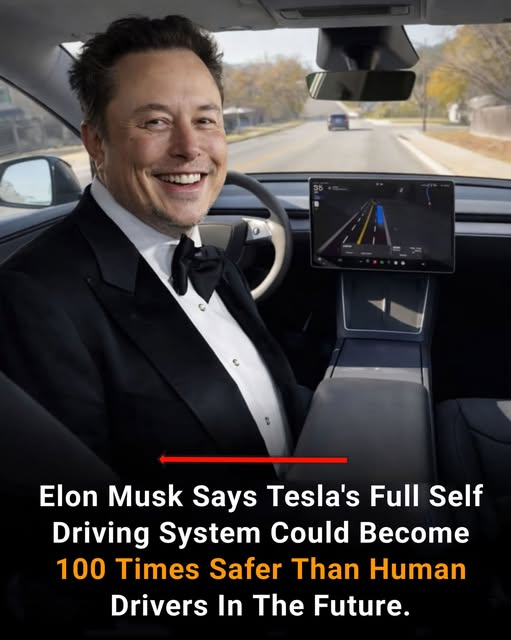
Elon Musk once again sparked intense debate across the tech and automotive worlds with a bold statement: Full Self-Driving (FSD) from Tesla could become dozens, even hundreds of times safer than human drivers in the future. Crucially, Musk argues this is not because humans are poor drivers, but because software does not suffer from biological limitations.
In explaining his view, Musk points to a simple but uncomfortable truth: humans get tired, lose focus, become emotional, and make split-second mistakes. A moment of drowsiness, a glance at a phone, or a flash of anger can instantly turn into a serious accident. Software, by contrast, does not get sleepy, distracted, or emotionally compromised.
According to Musk, this difference is decisive. FSD doesn’t need rest, doesn’t look away, and can maintain full attention 24/7. While humans drive using instinct and personal experience, autonomous systems rely on algorithms, data, and continuous real-time analysis. In Musk’s framing, this is not a battle of “humans versus machines,” but a comparison between biological limits and technological precision.
One point Musk repeatedly emphasizes is FSD’s ability to learn at scale. Millions of Tesla vehicles on roads worldwide constantly collect data from real driving situations. Every mistake is recorded. Every successful avoidance of danger becomes a lesson. Most importantly, a mistake learned by one vehicle can prevent millions of others from repeating it.
This “drive–learn–update–improve” loop is why Musk believes FSD can evolve faster than any human driver. While a person may need years to accumulate experience, software can improve after a single update. Over time, the gap between human reaction limits and machine accuracy could widen dramatically.
Musk’s statement also hints at a future where road safety is fundamentally redefined. Accidents—long considered an unavoidable cost of mobility—could become rare if most vehicles are controlled by systems that never tire, never lose focus, and never act on emotion. In that world, human driving itself may be viewed as the greater risk rather than the solution.
To be clear, Musk is not claiming that FSD already meets this standard today. But the way he frames the argument suggests this is no longer a question of “if,” but “when.” If that future arrives, it would not only reshape Tesla, but force changes across transportation, regulation, and society’s relationship with the steering wheel.