
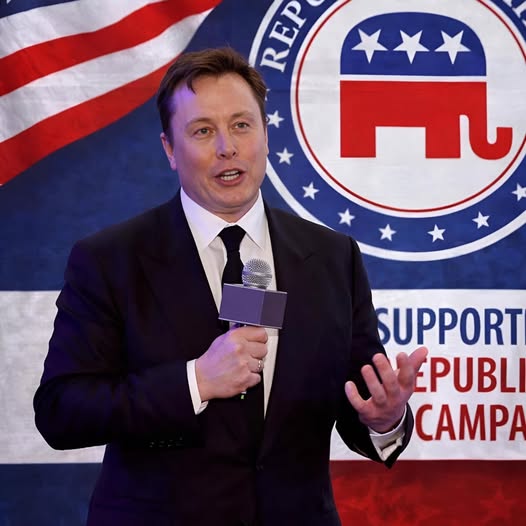
In recent weeks, U.S. political circles and the media have paid growing attention to reports suggesting that Elon Musk — the founder of Tesla and SpaceX — may be quietly re-entering partisan politics, this time by supporting Republican campaigns ahead of the 2026 U.S. midterm elections. Although no official confirmation has been made, the story has quickly gained traction due to Musk’s immense influence not only in technology and business, but also in public discourse and politics.
According to speculative reports circulating online, after years of publicly clashing with Democratic leaders over issues such as content moderation, taxation, technology regulation, and free speech, Musk appears to be leaning closer to the Republican Party. Some sources even suggest that his previously tense relationship with former President Donald Trump may be “thawing” behind the scenes after a period of sharp public criticism between the two.
What makes the story particularly controversial is the way it is being framed. Words like “quietly,” “behind closed doors,” and “without public acknowledgment” are frequently used. As of now, there is no official filing from the Federal Election Commission (FEC) confirming that Elon Musk has made large-scale, direct donations to Republican campaigns tied specifically to the 2026 midterms. Nor has Musk publicly stated that he is formally backing any particular party or candidate.

Even so, the rumor continues to spread — and not without reason. Over the past few years, Musk has become increasingly outspoken about political and cultural issues, especially on social media. He has repeatedly criticized Democratic policies that he believes hinder innovation, business growth, and free expression, while voicing support for more conservative positions on economic freedom and government overreach. This shift in tone has led many observers to believe that Musk “choosing a side” may be inevitable.
Another factor fueling the speculation is the changing role of money and technology in modern politics. Billionaires like Musk do not necessarily need to make loud endorsements or headline-grabbing donations to exert influence. Financial backing, media reach, and indirect control over public narratives can be just as powerful. In this context, the idea that Musk could be quietly supporting Republican efforts feels plausible to many observers.
However, political analysts caution that this may also be a case of narrative-driven speculation rather than confirmed reality. Many of the articles pushing the story rely on vague language and unnamed sources, offering little concrete evidence. Phrases such as “sources believe,” “it appears,” and “quiet moves suggest” are common — effective for drawing attention, but weak when it comes to verification.

Elon Musk himself has previously insisted that he is not loyal to any single political party, stating instead that he supports policies he believes benefit innovation, economic growth, and the future of the United States. In the past, Musk has donated to both Democratic and Republican candidates, depending on the political landscape at the time. This history complicates attempts to label him as firmly aligned with one side.
Ultimately, the claims that Elon Musk is quietly intervening in the 2026 U.S. elections remain unconfirmed and speculative. Still, the discussion highlights a broader reality: the growing influence of tech billionaires in American politics. When figures like Musk make even subtle moves, they can spark intense debate and speculation about power, influence, and the future of democracy.
The larger question remains unanswered. Is Elon Musk truly choosing a political side, or is he attempting to rewrite the rules of political influence altogether? As the 2026 midterms approach and financial disclosures become public, the answers may finally come into focus. Until then, the story continues to sit at the intersection of money, technology, and power — a space where perception can be just as impactful as reality.