
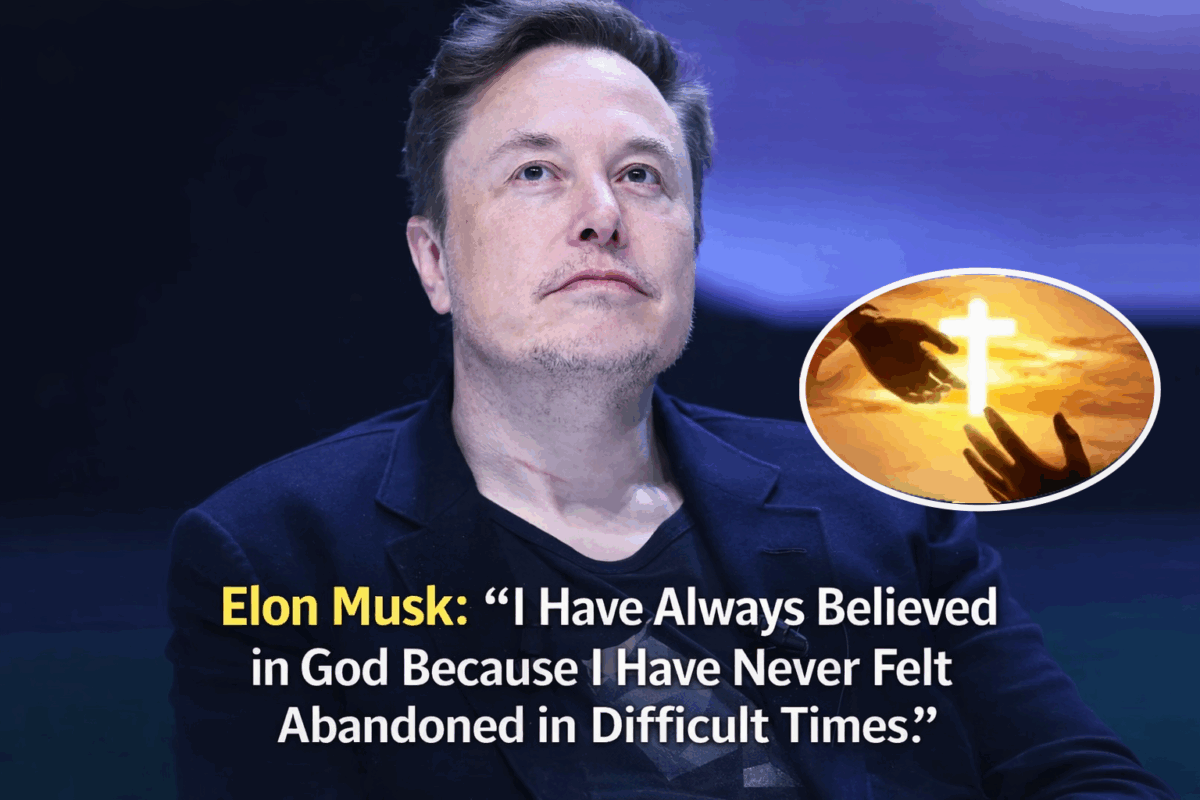
In the ever-changing world of technology—where every decision carries enormous risk and constant pressure—it is rare to hear leading figures speak about faith in such a personal and understated way. Yet a statement recently circulating online by Elon Musk — “I have always believed in God because I have never felt abandoned in difficult times” — has quickly drawn attention and sparked widespread discussion.
What captured public interest was not simply Musk’s mention of God, but the way he connected faith with real-life experience. Throughout his career, Musk has faced moments that seemed almost impossible to overcome: Tesla teetering on the edge of bankruptcy, repeated launch failures at SpaceX, and relentless financial and media pressure. Still, he has often described these moments not as total collapse, but as trials that could be endured.
According to common interpretations on social media, Musk’s words do not suggest belief in a specific miracle. Instead, they reflect a recurring feeling that a path forward tends to appear at the most critical moments, even when everything initially seems hopeless. That path might take the form of a crucial decision, the right person arriving at the right time, or simply the determination to move forward when most would give up.

What makes this statement particularly striking is that Musk has long been viewed as a symbol of science, technology, and rational thinking. For that reason, his reference to God or spiritual belief surprised many. However, upon closer examination, his words do not reject science at all. Rather, they highlight something else: the limits of human control. When calculations are exhausted and logic offers no immediate answer, faith—whatever name one gives it—can become a source of strength to keep going.
Many supporters believe that this sense of “not being abandoned” is what has helped Musk maintain resilience. Instead of sinking into despair, he continues to work, experiment, and accept failure as part of the journey. From this perspective, faith does not replace effort; it prevents effort from breaking down.
Of course, there are also voices cautioning against over-interpreting the statement. Musk did not declare a religious conversion, nor did he encourage others to follow his beliefs. He simply shared a personal inner experience: the feeling of spiritual support during times of adversity. In an online environment that often favors absolute claims, this personal and restrained tone may be exactly why the statement spread so quickly.

On a broader level, Musk’s words resonate with a universal human experience. When facing dead ends, people often need more than technical solutions—they need the belief that they are not alone. Whether that belief is called God, destiny, or a deeper meaning in life, it can give individuals the strength to rise after repeated setbacks.
Ultimately, Elon Musk’s statement does not redefine him as a businessman or technologist. But it does reveal another side of him: behind the massive projects and ambitions that reach beyond Earth is a human being seeking a spiritual anchor to keep moving forward during life’s most difficult moments.