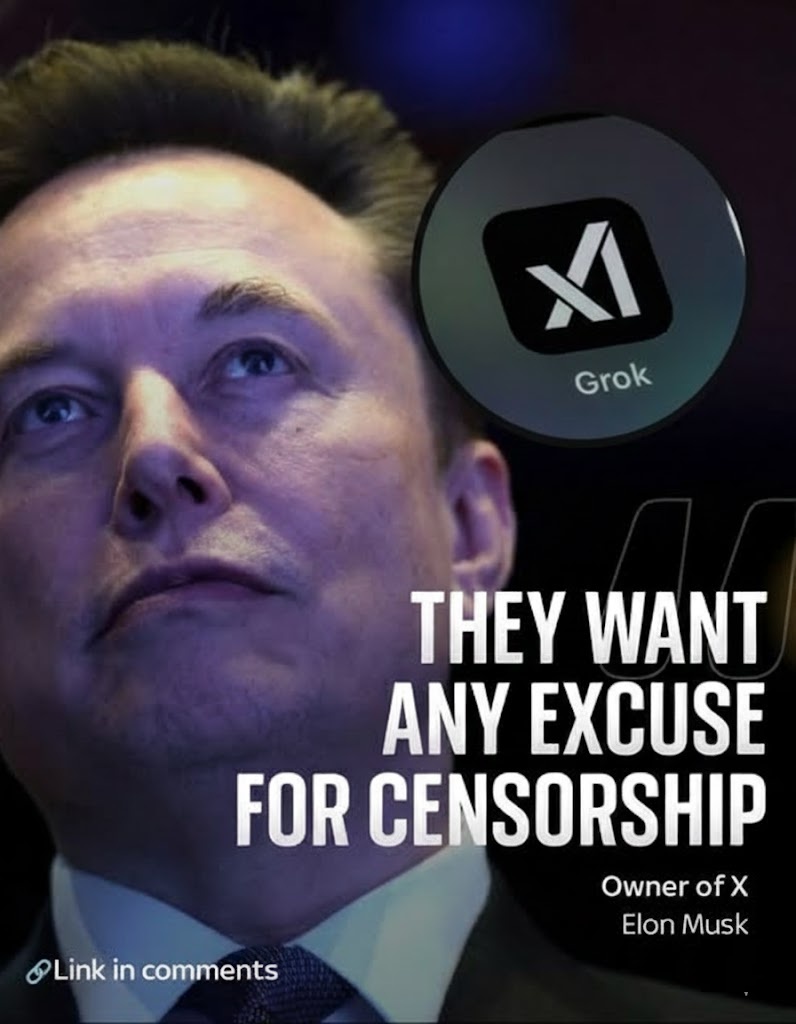
Debates surrounding artificial intelligence have intensified after Elon Musk was warned by regulators over Grok, the AI chatbot developed by xAI and integrated into the X. The issue has drawn widespread international media attention, including coverage by Sky News, as Musk publicly responded to growing concerns about content control and AI censorship.
According to reports, Grok has come under increased regulatory scrutiny due to concerns about its ability to generate sensitive or potentially inappropriate content that may not align with existing moderation standards. As governments—particularly in Europe—move to tighten regulations on artificial intelligence and large technology platforms, Grok’s positioning as a more “lightly moderated” AI system has placed it firmly in the spotlight.
In response to these warnings, Elon Musk has not shied away from controversy. He argues that the issue extends far beyond Grok itself, reflecting a broader trend in which AI is increasingly being used as a justification for expanding censorship in the digital space. In remarks widely circulated online, Musk stated that “they want any excuse for censorship,” suggesting that governments and regulators are exploiting AI safety concerns to exert greater control over online speech.

This stance is consistent with Musk’s long-held views since acquiring Twitter, later rebranded as X. He has repeatedly positioned himself as a defender of free speech, while criticizing what he sees as excessive moderation by major technology companies. Grok, according to Musk, was designed to be more direct, capable of challenging assumptions, and less constrained by rigid content filters than many competing AI chatbots.
That very approach, however, has made Grok a focal point of regulatory concern. As AI systems increasingly influence public discourse, politics, and information flows, regulators argue that insufficient oversight could enable the spread of harmful or misleading content. From their perspective, the warnings directed at Grok form part of a broader effort to establish clearer legal and ethical frameworks governing AI technologies.
Sky News notes that Musk’s reaction highlights a growing clash between governments and technology leaders over who should control digital platforms and AI-generated content. On one side are policymakers emphasizing safety, accountability, and societal risk management. On the other are tech entrepreneurs advocating innovation and freedom of expression, warning that excessive regulation could stifle progress.
Notably, as of now, no official ban or legal sanction has been imposed on Grok. The actions taken so far appear to be precautionary warnings and calls for compliance rather than punitive measures. Even so, the situation underscores the mounting pressure AI platforms may face as regulatory oversight continues to expand globally.
The controversy also illustrates a wider dilemma confronting the AI industry: how to balance open dialogue and creativity with the need to prevent harm. As AI tools become more powerful and accessible, the question of where to draw the line between moderation and censorship remains deeply contested.
In summary, Elon Musk being “scrutinized” over Grok is about far more than a single chatbot. It reflects a global debate over the boundaries between free speech and censorship in the age of artificial intelligence. Musk’s outspoken response signals that this confrontation is unlikely to fade anytime soon, as AI continues to sit at the center of both technological innovation and regulatory controversy.