
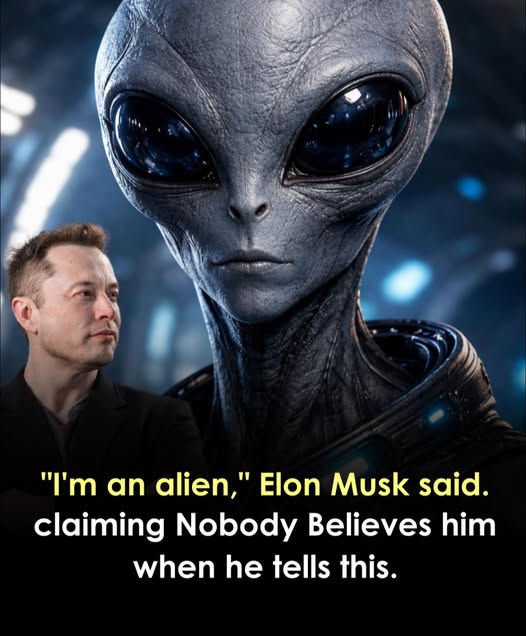
At the World Economic Forum (WEF) in Davos, Elon Musk once again became the center of international attention — not because of technology, AI, or SpaceX, but due to a humorous remark about aliens. When asked whether extraterrestrials might be living among humans, Musk smiled and replied, “I’ll say that I am one.” The answer immediately drew laughter from the audience, and as expected, social media quickly picked up on the moment.
In reality, this was clearly a sarcastic joke. There was no serious claim, no evidence presented, and no hidden implication. Those present at the event understood it as lighthearted humor delivered in classic Elon Musk style — witty, slightly quirky, and perfectly suited for headlines. As a result, the general public reaction was simply amusement. No one actually believed that Musk was declaring himself an alien.
Still, the story did not end there. Within hours, numerous social media pages reposted the quote, often paired with dramatic alien imagery, eye-catching headlines, and captions designed to spark curiosity. A harmless joke quickly became meme material, detached from its original context and circulated as entertainment content. This is a textbook example of how social media can transform a humorous moment into viral news.

Elon Musk is well known for his unconventional communication style. In the past, he has joked about artificial intelligence taking over humanity, Mars becoming a “Plan B” for civilization, and other ideas that sound straight out of science-fiction films. This approach has made him both widely admired and frequently controversial. To some, Musk is a visionary thinker far ahead of his time; to others, he is a businessman who enjoys attracting attention through provocative or unusual statements.
In this particular case, most people easily recognized the humor behind his words. There was no public backlash, no scientific or political controversy, and no serious conspiracy theories emerging from the comment. The fact that “no one believes him” is actually a positive sign — it shows that audiences can still distinguish between a joke and a genuine claim.

The incident also highlights a familiar reality of the social-media era: the line between news and entertainment is increasingly blurred. A playful comment, when removed from its original context or framed with sensational visuals, can easily be mistaken for breaking news. That is why readers need to remain cautious, paying attention to sources and circumstances rather than relying solely on headlines or images.
Ultimately, Elon Musk “claiming to be an alien” is not a shocking revelation or a hidden confession. It was simply a humorous moment at Davos, fully in line with Musk’s personality, later amplified by social media for entertainment value. People laughed, shared the memes, and moved on — continuing to focus on Musk’s real technological ambitions rather than believing that an alien is secretly running SpaceX or Tesla.