
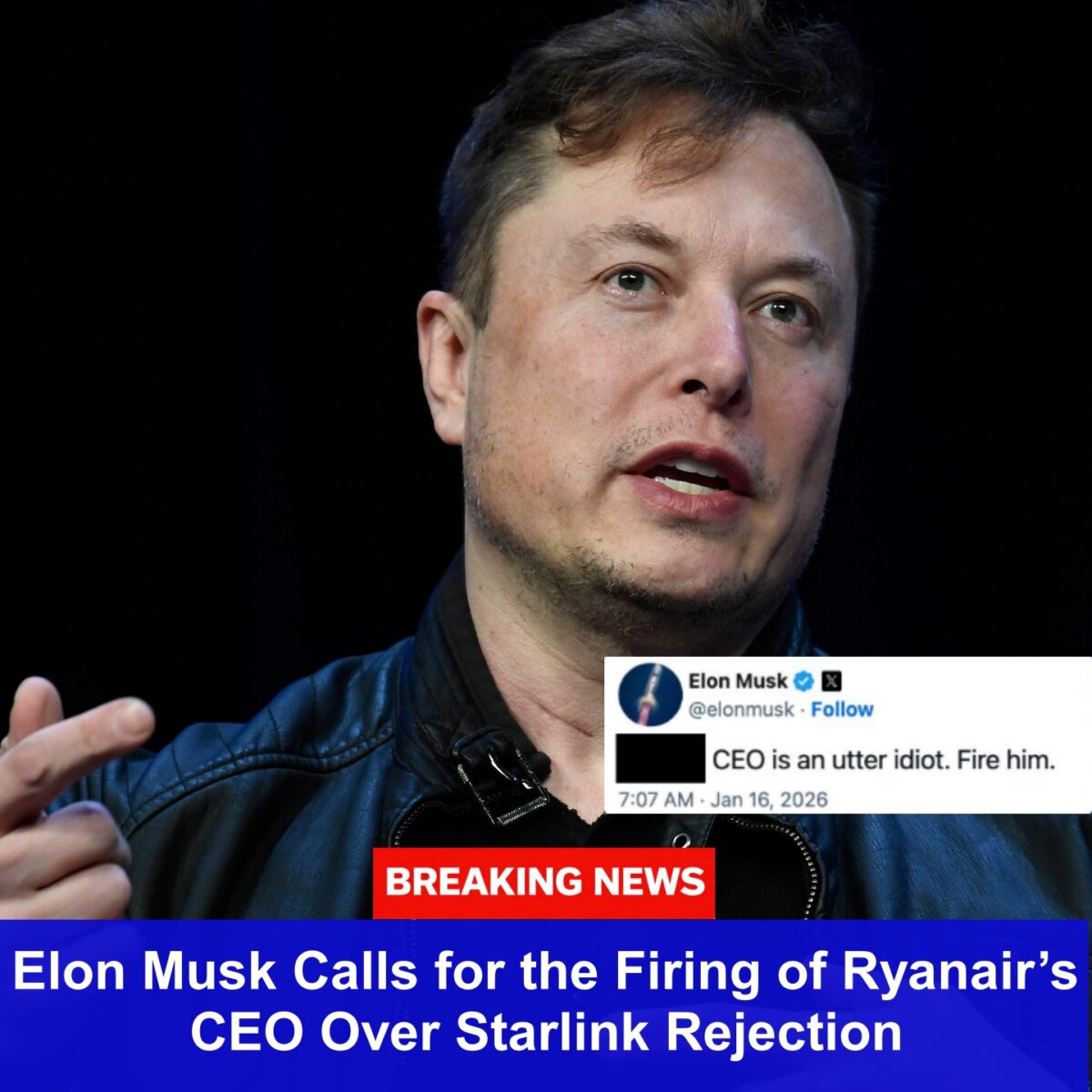
The dispute between Elon Musk and the leadership of Ryanair has unexpectedly escalated into a public war of words, centered on the airline’s decision to reject the installation of Starlink satellite Wi-Fi on its aircraft. Tensions peaked when Musk openly called for the dismissal of Ryanair’s CEO, Michael O’Leary, following blunt remarks criticizing Starlink and its suitability for commercial aviation.
The controversy began after Ryanair reaffirmed its stance against adopting Starlink across its fleet. According to O’Leary, mounting satellite antennas on aircraft would increase both weight and aerodynamic drag, leading to higher fuel consumption. He estimated that Starlink could impose a so-called “fuel penalty” of around 2 percent—an increase that is far from trivial for an ultra-low-cost carrier whose business model depends on razor-thin margins. With thousands of flights operating daily, even a small percentage rise in fuel costs could significantly impact profitability.
Musk swiftly pushed back. Posting on social media platform X, he rejected O’Leary’s claims and argued that Starlink has already demonstrated superior speed and reliability compared with many existing in-flight Wi-Fi systems. Musk did not stop at a technical rebuttal. In a series of pointed comments, he labeled Ryanair’s CEO an “utter idiot” and publicly urged that he be fired, turning what began as an industry debate into a highly personal confrontation.
Starlink, operated by SpaceX, has been gaining traction among airlines seeking to upgrade passenger connectivity. The system promises high bandwidth and low latency even on long-haul routes, qualities that supporters say can transform the in-flight experience. Proponents argue that fast, reliable internet has become an expectation rather than a luxury, and airlines that fail to invest risk falling behind competitors. From this perspective, Musk’s defenders believe that improved passenger satisfaction and potential ancillary revenues could outweigh the additional operating costs.
Ryanair’s position, however, reflects a different philosophy. Unlike full-service or premium carriers, Ryanair has built its brand around offering the lowest possible fares, often by stripping out services that do not clearly contribute to profitability. From this standpoint, high-speed in-flight Wi-Fi—while attractive—remains a discretionary upgrade rather than a necessity. O’Leary has long been known for prioritizing cost discipline over comfort enhancements, and the Starlink decision fits squarely within that strategy.

The Musk–O’Leary clash therefore highlights a broader divide within the aviation industry: the tension between aggressive technological innovation and uncompromising cost control. While some airlines see connectivity as a competitive differentiator, others view it as an expense that undermines their low-fare promise. For now, there is no indication that Ryanair plans to reverse course, despite the publicity generated by Musk’s comments.
Ultimately, the episode underscores how Starlink continues to polarize opinion in aviation. As passenger expectations evolve and fuel costs remain volatile, airlines face difficult choices about where to invest. Whether Musk’s outspoken criticism will influence those decisions remains to be seen, but the debate has firmly placed satellite internet at the center of the industry’s future discussions.