
The vision of using technology to reshape education has long been discussed, but few initiatives have sparked as much global attention as Elon Musk and the expansion of Starlink into schools. What once sounded like a futuristic experiment is now increasingly being viewed as a practical solution for one of education’s biggest challenges: access to reliable internet.
Across the world, millions of students still struggle with limited or unstable connectivity. In rural regions, disaster-prone areas, and underserved communities, traditional broadband infrastructure is either unreliable or completely unavailable. This digital divide has placed many schools at a disadvantage, preventing students from accessing modern learning tools, online resources, and global knowledge networks.
Starlink, SpaceX’s satellite-based internet system, offers a different approach. Instead of relying on ground cables and local infrastructure, Starlink uses a constellation of low-Earth-orbit satellites to deliver high-speed internet directly from space. For schools in remote or isolated locations, this technology can be transformative.

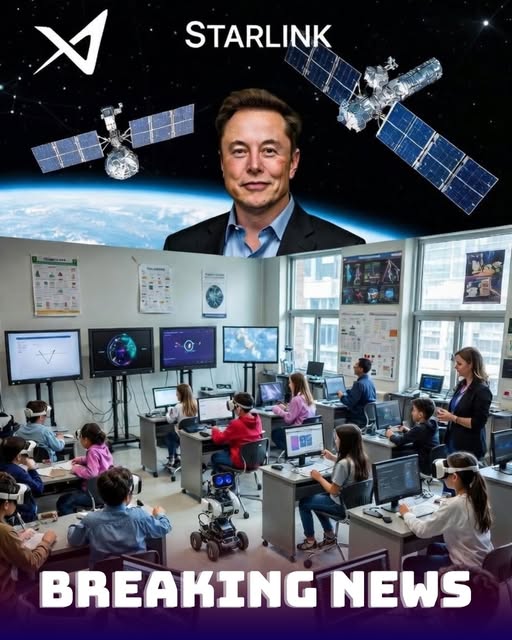
Images circulating online show classrooms filled with students using computers, digital displays, and interactive learning systems — all connected through satellite internet. The message is clear: with stable connectivity, education no longer has to be limited by geography. Lessons, research materials, virtual classrooms, and collaboration with educators around the world become possible in places that were once left behind.
Supporters of the initiative argue that bringing Starlink to schools is not just about faster internet. It is about equal opportunity. When students have access to the same digital tools as their peers in major cities, they gain a fairer chance to develop skills needed for the modern world. Coding, digital literacy, remote learning, and real-time access to information are no longer luxuries — they become part of everyday education.
For teachers, reliable internet access can change how classrooms operate. Educators can integrate multimedia lessons, live demonstrations, and global educational platforms into their teaching. Schools can also maintain continuity during emergencies, such as natural disasters or public health crises, when in-person learning becomes difficult.

Elon Musk has repeatedly emphasized that technology should serve humanity, and Starlink’s educational applications align with that philosophy. While Starlink is not universally free, partnerships, pilot programs, and targeted deployments for schools and institutions suggest a growing focus on educational access rather than pure commercial use.
Critics note that large-scale implementation still faces challenges, including cost, equipment availability, and coordination with governments and school systems. However, even limited deployments demonstrate what is possible when advanced technology is directed toward social impact.
As more classrooms gain access to satellite internet, the definition of a “modern school” may change. Education no longer depends solely on physical location or local infrastructure. Instead, it becomes connected, global, and adaptive.
Whether Starlink ultimately becomes a standard tool in education remains to be seen. But one thing is clear: by bringing satellite internet closer to schools, Elon Musk and Starlink are pushing education toward a future where knowledge is no longer restricted by distance — and where every classroom has the potential to connect with the world.