
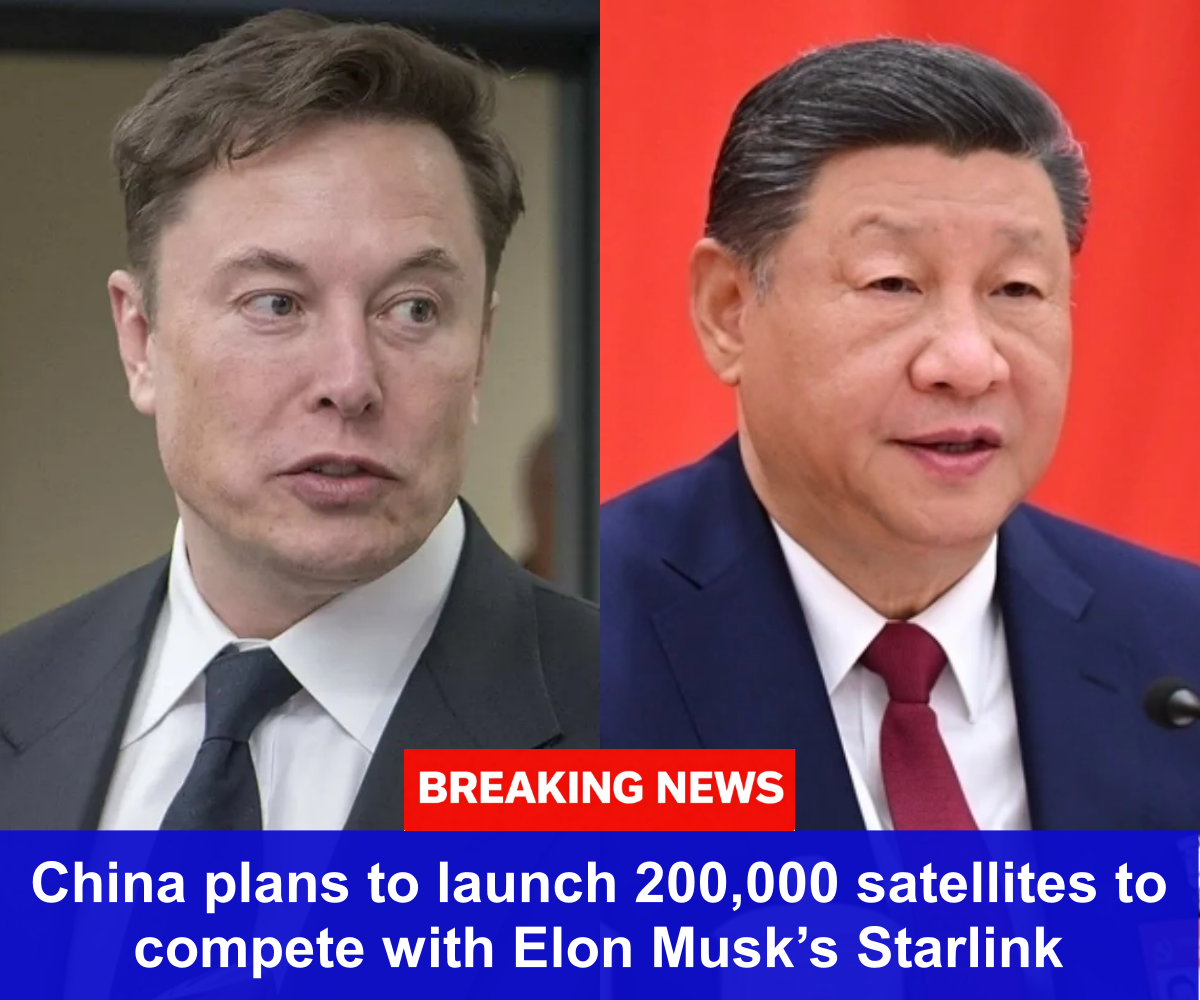
A new front is emerging in global technological competition as China prepares an ambitious plan to launch up to 200,000 satellites into low Earth orbit. The move is widely seen as a direct challenge to Starlink, the satellite internet network operated by Elon Musk. The plan signals what many experts describe as a looming “satellite war” in space, with far-reaching consequences for geopolitics, security, and the future of global communications.
Starlink, developed by SpaceX, has already deployed thousands of satellites and currently leads the race to provide global broadband internet, particularly in remote and underserved regions. Its rapid expansion has reshaped satellite communications by delivering high-speed, low-latency connectivity capable of competing with traditional ground-based networks. However, Starlink’s growing reach has also raised concerns among governments about reliance on a space-based infrastructure controlled by a private U.S. company.
China’s proposed megaconstellation is designed to counter that influence. According to reports, the project would involve multiple state-backed aerospace firms and could ultimately surpass Starlink in scale. By placing such a massive number of satellites into orbit, Beijing aims not only to compete commercially but also to secure strategic autonomy in space-based communications.
From a geopolitical perspective, the move reflects intensifying tensions between China and the United States over advanced technologies. Space is increasingly regarded as a critical domain alongside land, sea, air, and cyberspace. Control over satellite networks affects everything from civilian internet access and navigation services to military communications and intelligence gathering. For China, reducing dependence on foreign satellite systems is viewed as a matter of national security.

The sheer scale of the plan has raised alarms among space experts. Launching hundreds of thousands of satellites would dramatically increase congestion in low Earth orbit, heightening the risk of collisions and the accumulation of space debris. A single major collision could trigger a cascading effect—known as the Kessler Syndrome—potentially rendering portions of orbit unusable for decades. International regulators and space agencies have warned that existing governance frameworks may be insufficient to manage such rapid and large-scale expansion.
Environmental concerns also feature prominently in the debate. Frequent rocket launches contribute to atmospheric pollution, while deorbiting satellites may affect the upper layers of the atmosphere. Astronomers have additionally criticized large satellite constellations for interfering with ground-based observations, arguing that the night sky is becoming increasingly crowded.
For Elon Musk, China’s plan represents the most serious challenge yet to Starlink’s dominance. While Starlink enjoys a first-mover advantage and a rapidly growing user base, competition from a state-backed Chinese network could reshape pricing, coverage, and access—particularly in regions aligned with Beijing. The rivalry could result in parallel satellite ecosystems divided along political and economic lines.
Ultimately, the emerging “satellite war” underscores how space has become a central arena of global competition. What began as a race to provide internet connectivity is evolving into a strategic struggle for influence beyond Earth’s atmosphere. As China accelerates its plans and Starlink continues to expand, the world may soon witness an unprecedented contest in orbit—one that could redefine power, connectivity, and security in the 21st century.