
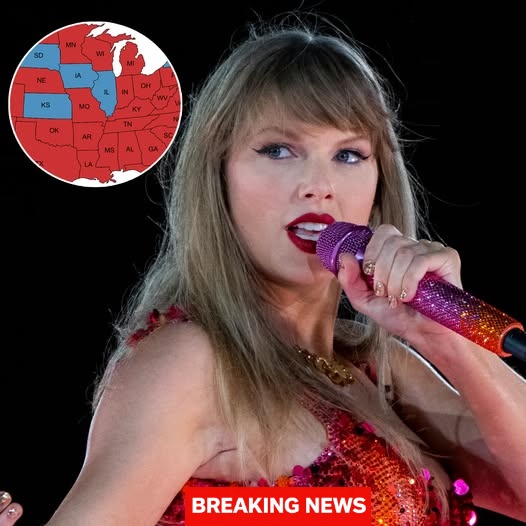
Taylor Swift—once seen as untouchable at the peak of the American entertainment industry—has become the focal point of an unprecedented political controversy. As her influence stretches from music and pop culture into the realm of elections and civic debate, a boycott movement from conservative “Red States” is widely reported to have triggered a financial setback estimated at $1 billion, raising sharp questions about the boundary between art and politics.
According to analyses circulating across social media and U.S. political commentary, the backlash intensified after Taylor Swift made her positions on social and electoral issues more explicit. In a nation deeply polarized, the image of a global pop star suddenly became intertwined with America’s red–blue divide, turning each public move into not just entertainment news but a political signal.
The boycott campaign spread rapidly, calling for consumers to shun concert tickets, merchandise, and even brands associated with Taylor Swift in certain conservative regions. While the real-world impact remains debated, many observers argue that the combined effect—lost potential sales, paused partnerships, and weakened market demand in key areas—has translated into a massive financial hit, widely estimated at around $1 billion.
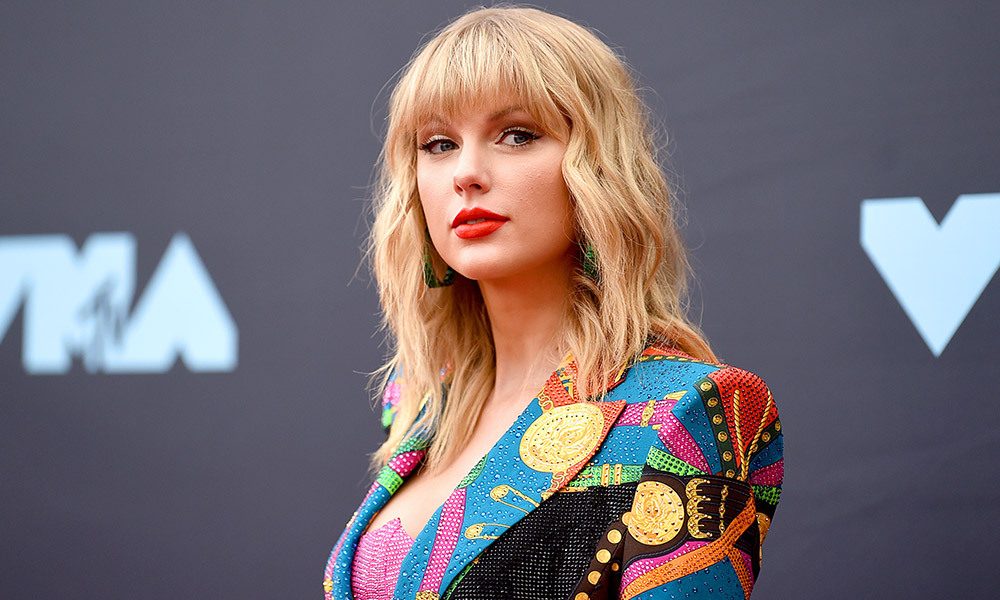
What has captured public attention is the claim that Taylor Swift did not anticipate the scale of the backlash. For years, she had largely avoided overt political involvement, focusing instead on cultivating her image as a music-first artist. However, once she became a cultural figure whose reach extends far beyond the charts, remaining silent was no longer a viable option. Choosing to speak out—while applauded by supporters—also exposed the harsher consequences of political polarization.
Online discourse quickly split into opposing camps. One side argues that Taylor Swift has both the right and the responsibility to use her platform to influence society, and that any boycott is simply the cost of standing by one’s values. The other side contends that entertainers should remain neutral, insisting that the reported $1 billion slide is the inevitable result of “bringing politics onto the stage.”

The controversy has reignited a broader debate: can global superstars truly stay outside politics in today’s climate? When every statement can sway millions, the line between art, commerce, and personal belief grows increasingly fragile.
While the $1 billion figure remains contested, there is little doubt that Taylor Swift is navigating a genuine storm. This is no longer just a story about revenue—it is a case study in the weight of cultural power within a divided society. For Taylor Swift, this moment may stand as one of the most controversial chapters of a career otherwise defined by record-breaking success and global acclaim.