
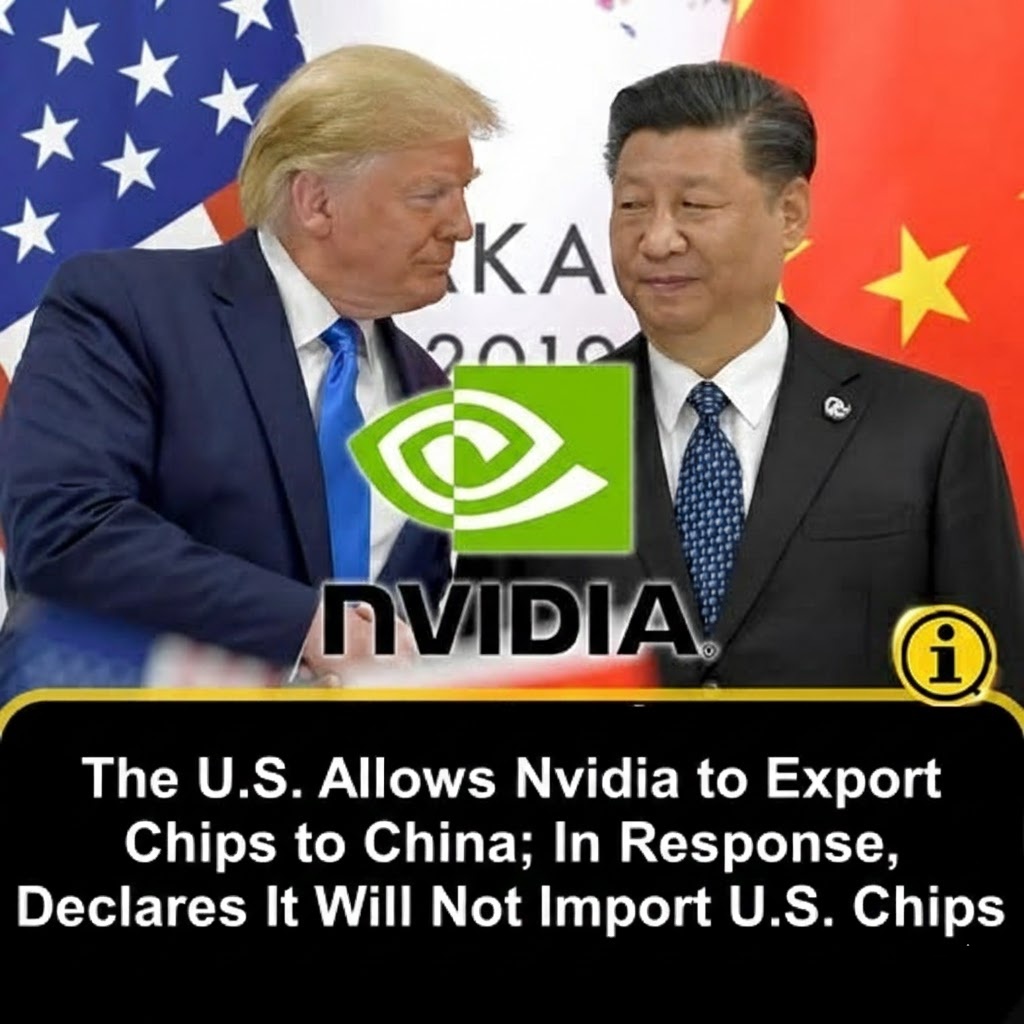
The United States government is reported to have approved Nvidia to export its H200 AI chips to China, but only under strict licensing conditions rather than through a broad market opening. This move is seen as a calibrated adjustment to Washington’s technology export controls, aimed at balancing national security concerns with the commercial interests of U.S. semiconductor firms.
However, Beijing’s response has moved in the opposite direction. According to a report by Reuters, China’s General Administration of Customs has issued internal guidance stating that Nvidia’s H200 AI chips are not permitted to be imported into the country. The information, cited from three sources familiar with the matter, indicates that authorities have also advised domestic technology companies not to purchase the chips unless they are “absolutely necessary.” In some communications, the guidance has been interpreted as amounting to a temporary ban.
These contrasting moves underscore the complexity of the ongoing U.S.–China technology rivalry. While the United States appears to be seeking a middle ground—allowing limited exports to protect the competitiveness of its companies without fully relaxing controls—China is signaling that it is unwilling to rely on advanced U.S. AI hardware amid prolonged geopolitical tensions.
Nvidia’s H200 chip is a flagship product designed for training and running large-scale AI models, powering data centers, and supporting high-performance computing workloads. Washington’s conditional approval to export the chip is widely viewed as a concession to pressure from U.S. businesses concerned about losing access to the Chinese market. Nevertheless, Beijing’s decision to block imports sends a clear message that China is prepared to respond using regulatory tools while accelerating its push for self-sufficiency in semiconductors.
From a political standpoint, China’s move is widely interpreted as an assertion that the rules of the game are not dictated by one side alone. Whether the United States tightens or loosens its export restrictions, Beijing retains policy levers to shape outcomes in line with its long-term strategic objectives. The stance also serves to reassure domestic firms that the government prioritizes building local supply chains over dependence on foreign technologies that could be cut off or constrained.
In the short term, refusing imports of the H200 chip may require Chinese companies that rely heavily on advanced AI computing power to make adjustments, potentially seeking alternative solutions or optimizing existing resources. Over the longer term, however, the policy is likely to accelerate investment in domestic chip development and the search for substitutes that reduce exposure to external controls. For Nvidia and the broader U.S. semiconductor industry, the episode highlights the persistent risks associated with accessing the Chinese market—even when export licenses are granted.
Ultimately, the dispute over the H200 chip goes beyond a simple commercial transaction. It reflects the broader strategic contest between the world’s two largest economies over technological leadership in artificial intelligence. The U.S. decision to allow exports, followed by China’s refusal to import, illustrates how every move in the global AI race carries political and strategic weight, shaping not only market outcomes but also the future balance of technological power.