
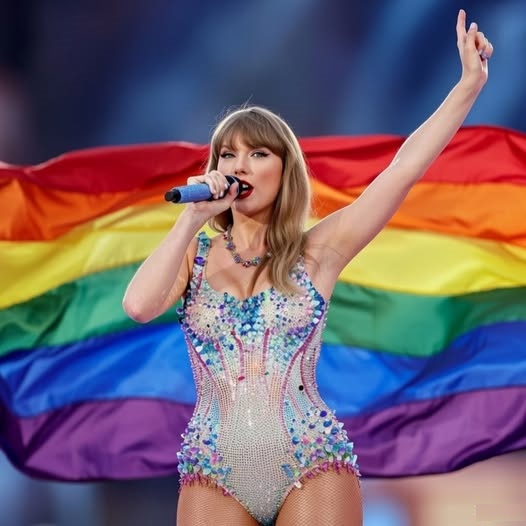
Taylor Swift has long been regarded as one of the most influential artists in contemporary music. However, her impact extends far beyond record-breaking sales and sold-out tours. It is also reflected in the way she speaks up and takes action on social issues. When it comes to the LGBTQ+ community, Taylor Swift has made it clear that her support does not stop at Pride symbols on stage, but continues through concrete and meaningful actions behind the scenes.
Over the years, images of Taylor Swift alongside Pride flags, rainbow colors, and messages celebrating diversity have become familiar to fans worldwide. What has earned her even greater respect, however, is her refusal to let those symbols remain purely performative. Instead, Taylor Swift has reportedly donated to organizations working to challenge laws and policies viewed as discriminatory toward the LGBTQ+ community, particularly in regions where equality remains a highly contested issue.
These contributions carry significance beyond their financial value. When a global superstar with tens of millions of followers publicly supports and stands alongside advocacy organizations, the message of equality gains far greater visibility. Such actions help bring public attention to LGBTQ+ causes and encourage others to contribute, whether through donations, activism, or simply greater awareness and understanding.

Taylor Swift has previously expressed the belief that remaining silent in the face of injustice is a form of complicity. This mindset has driven her to move beyond vague statements of support and toward tangible action. At a time when certain laws have been criticized for undermining LGBTQ+ rights, open support from a figure of her stature serves as a powerful source of encouragement for affected communities.
Of course, taking a public stance on social issues often invites controversy. Taylor Swift has faced criticism from those who argue that artists should focus solely on their music rather than engage with politically or socially sensitive topics. Despite this, she has remained firm in her position, emphasizing that art and social responsibility are not mutually exclusive. In her view, they can and should coexist to promote positive change.
Media and cultural analysts note that Taylor Swift’s approach reflects a broader shift among major artists today. Increasingly, high-profile figures are expected not only to signal support through imagery or slogans, but also to commit real resources and sustained attention to the causes they endorse. This shift moves public discourse away from symbolic gestures and toward actions that can lead to lasting, measurable impact.
By going beyond Pride symbols and supporting organizations that oppose anti-LGBTQ+ legislation, Taylor Swift has demonstrated a clear commitment to equality. Her actions underscore the idea that allyship is not defined solely by visibility, but by willingness to act when it matters. With her global reach and influence, each step she takes contributes to a wider conversation about inclusion, respect, and human rights.
Ultimately, Taylor Swift’s example highlights the evolving role of artists in modern society. No longer confined to entertainment alone, influential figures now play a part in shaping social values. In choosing to back her words with action, Taylor Swift reinforces the message that true support for equality requires more than symbols—it requires meaningful, sustained effort.