
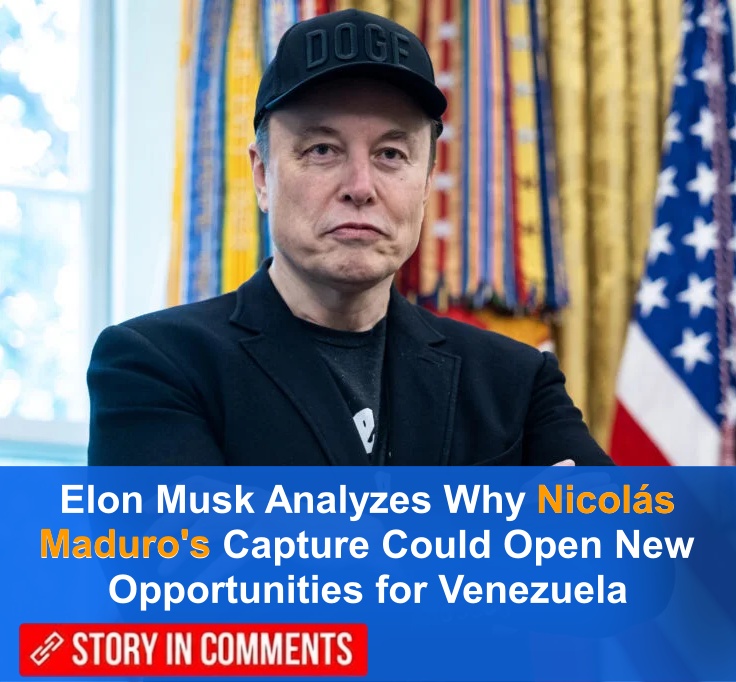
Reactions and analyses surrounding the political upheaval in Venezuela have drawn significant global attention, particularly after comments attributed to Elon Musk circulated widely. From this perspective, Musk suggests that the capture of Nicolás Maduro—within a transitional political context—could mark the beginning of a new chapter for Venezuela, not only politically but also economically and in the energy sector.
Venezuela represents a classic paradox of the “resource curse.” The country holds the world’s largest proven oil reserves, yet it has endured years of severe economic crisis marked by hyperinflation, shortages of essential goods, and one of the largest migration waves in the region’s history. The core problem, as many analysts note, is not a lack of resources, but persistent failures in governance and allocation.
From Musk’s energy-focused worldview—where energy underpins economic power—political change could create a narrow but meaningful opening to restructure Venezuela’s oil industry. For years, the state oil company PDVSA has been heavily politicized, underinvested, and operationally degraded. A reform-minded transitional authority could restore credibility and efficiency, enabling oil output to rebound faster than other sectors due to the country’s existing resource base.
Second, Maduro’s capture (within a transition scenario) could help Venezuela begin easing its international isolation. Sanctions and financial restrictions over the past years have constrained access to capital, technology, and markets. Musk has often emphasized that investment and innovation flow toward environments that are stable and predictable. A credible reform pathway would be a powerful signal to investors considering a cautious re-entry.
Third, the potential social benefits are substantial. Images of citizens celebrating—symbolic as they may be—reflect long-suppressed demand for change and for a fairer distribution of national wealth. Musk frequently argues that energy only delivers prosperity when paired with sound governance and open markets. If oil revenues are transparently reinvested into infrastructure, education, and healthcare, Venezuela could finally break free from single-commodity dependence.
Still, Musk has also warned—implicitly through his broader commentary—that replacing a leader does not automatically ensure durable reform. Venezuela faces deep structural challenges: diversifying the economy, rebuilding institutions, and restoring productivity beyond oil. Without these steps, the country risks repeating the same boom-and-bust cycle whenever energy prices fluctuate.

At the geopolitical level, a more stable Venezuelan energy sector could influence global oil markets. Given the scale of its reserves, even a partial recovery in output could affect prices and regional supply dynamics. This is an angle Musk—who closely tracks energy transitions and markets—would naturally consider when assessing broader implications.
In sum, analysis aligned with Elon Musk’s perspective suggests that Nicolás Maduro’s capture—within a genuine transition—could serve as a catalyst for positive change, provided reforms are substantive and sustained. Oil can be a lever for recovery, but the decisive factors will be transparent governance, open markets, and long-term investment in people. The opportunity may be emerging; whether Venezuela can seize it remains the central question.