
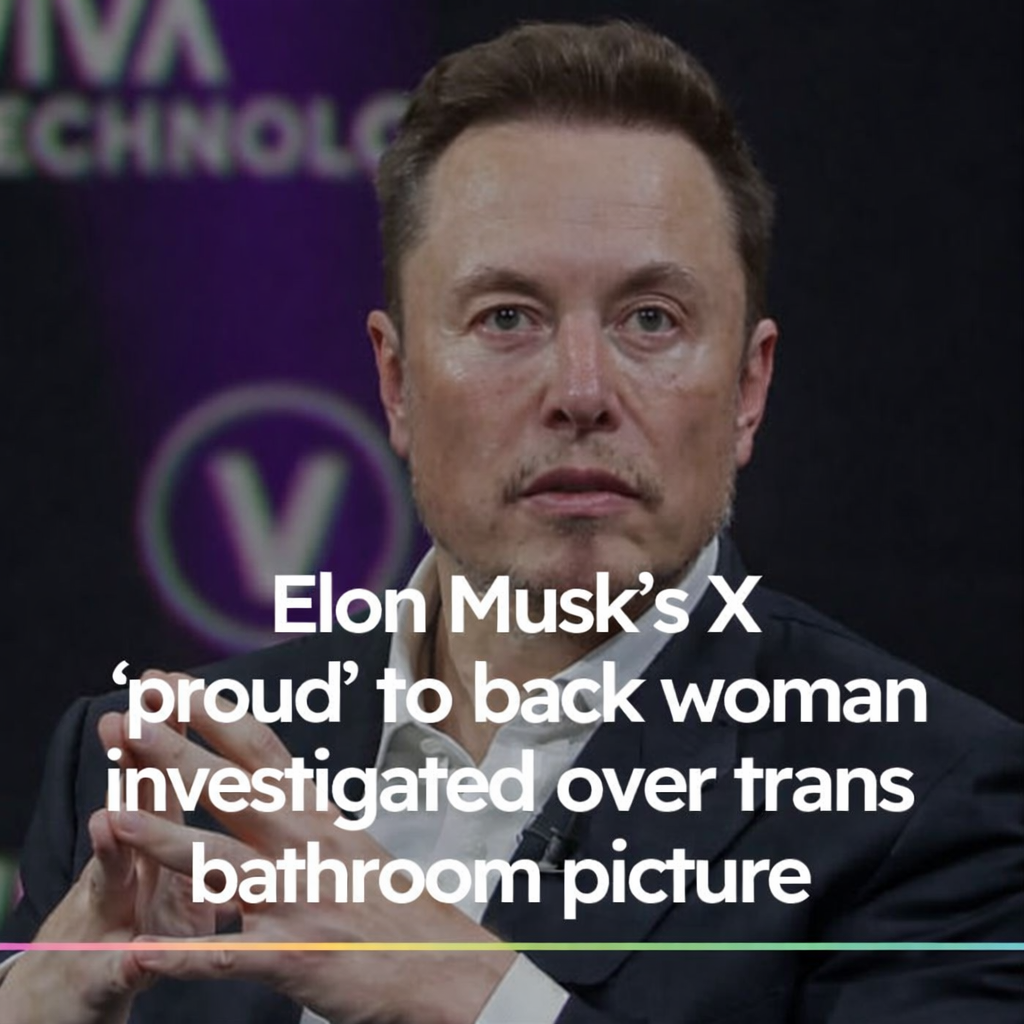
The social media platform X, owned by Elon Musk, has become the center of a new controversy in the United States after publicly announcing legal support for a Republican activist in Texas. The individual is facing potential criminal charges for resharing a photo involving a transgender woman using a women’s restroom inside the Texas State Capitol.
According to US media reports, the activist under investigation is Michelle Evans, chair of the Republican Party in Williamson County, Texas. The case dates back to 2023, when Evans attended a legislative hearing related to a proposed ban on gender-affirming medical care for minors. During the heated debate, a photo surfaced showing a transgender woman washing her hands in a women’s restroom. Evans later reshared the image on X, accompanied by commentary criticizing the situation.
That action triggered a criminal investigation under Texas law, which prohibits the distribution of images depicting individuals in private spaces such as bathrooms or changing rooms without their consent. Prosecutors argue that resharing such images may constitute an invasion of privacy, regardless of the political context or the public nature of the building where the photo was taken.
Evans has strongly pushed back against the investigation, arguing that her actions were protected by the First Amendment of the US Constitution. She filed a lawsuit seeking to block the investigation, claiming that prosecuting her would amount to an unconstitutional restriction on free speech. However, a federal appeals court earlier allowed the investigation to move forward, opening the door to possible criminal charges.
It was following that ruling that X’s Global Government Affairs team issued a statement saying the company was “proud” to support Evans in her legal challenge. According to the platform, the decision to provide legal assistance is rooted in its commitment to defending free expression online, a principle Elon Musk has repeatedly emphasized since acquiring the company formerly known as Twitter.
X’s statement stressed that the platform views free speech as a cornerstone of democracy and warned against what it described as the criminalization of political expression. The company also indicated it would help Evans pursue further appeals in an effort to overturn the decision allowing the investigation to continue.
The announcement immediately sparked intense backlash across social media and among civil rights advocates. Supporters of Evans and Musk argue that X is standing up for free speech at a time when political expression is increasingly under scrutiny. They contend that sharing an image taken inside a public government building, especially in the context of a legislative debate, should not lead to criminal prosecution.
On the other hand, LGBTQ+ advocacy groups and many legal experts have condemned the platform’s decision. They warn that distributing images of transgender individuals in sensitive settings such as restrooms can expose them to harassment, intimidation, and even physical harm. Critics argue that free speech protections should not be used to justify violations of personal privacy, particularly when vulnerable communities are involved.
The controversy also highlights the broader shift in content moderation and policy direction under Elon Musk’s leadership at X. Since taking over the platform, Musk has repeatedly criticized what he described as excessive moderation under previous management and has pledged to transform X into a “digital town square” where a wide range of viewpoints can coexist. However, cases like this have intensified concerns that the platform’s free speech absolutism may come at the expense of user safety and privacy.
As debates over gender identity, privacy rights, and political expression continue to polarize American society, the outcome of this case could have far-reaching implications. Legal experts note that it may set an important precedent regarding how far free speech protections extend when online content intersects with privacy laws and civil rights protections.
For now, the case remains unresolved, but it has already reignited national discussions about the balance between free expression and personal dignity in the digital age—debates that are likely to intensify as the legal process moves forward.