
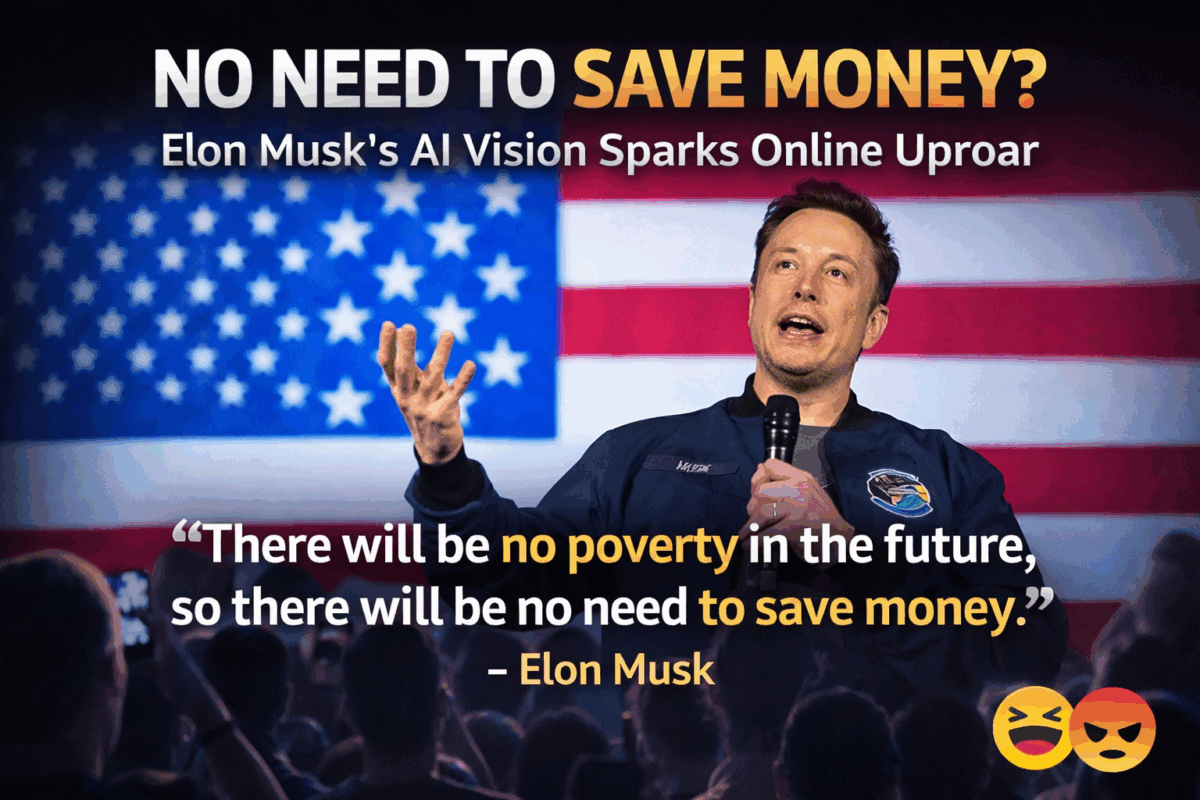
A statement attributed to Elon Musk has recently ignited intense debate across social media, drawing thousands of reactions ranging from sarcastic laughter to outright anger. The controversy centers on a future vision driven by artificial intelligence (AI), one in which poverty could be eliminated, raising a provocative question: would people still need to save money?
The quote circulating widely online reads:
“There will be no poverty in the future, so there will be no need to save money.”
The statement emerged in the context of Musk discussing the potential of AI to create a world without poverty, where automation dramatically increases productivity and abundance.
In several long-term discussions and interviews over the years, Musk has suggested that advanced AI and robotics could eventually push society toward an era of extreme abundance. In such a scenario, the cost of goods and services could approach zero, fundamentally reshaping how people think about work, income, and even money itself. Musk has previously floated the idea of “universal high income,” arguing that future societies may move beyond traditional employment models simply to survive.
However, the controversy lies in how this idea has been condensed and presented online. When reduced to a single, striking sentence, Musk’s broader philosophical outlook is often interpreted as practical financial advice for the present day. For millions of people struggling with rising living costs, debt, and economic uncertainty, the suggestion that saving money may become unnecessary feels detached from reality—and even insulting. This disconnect explains the wave of 😆 and 😡 reactions flooding social media.

Many critics argue that the statement reflects a billionaire’s perspective disconnected from everyday life. They point out that even if AI transforms the global economy, the transition will likely take decades and involve significant instability. Job displacement, income inequality, and uneven access to technology could all worsen before any utopian future becomes plausible. From this viewpoint, saving money remains essential for ordinary people navigating today’s economic pressures.
On the other side of the debate, supporters of Musk insist that his comments are being taken out of context. They emphasize that he is not telling people to stop saving money now, but rather offering a long-term prediction about how society might evolve under advanced AI. According to this group, the backlash stems from oversimplification and sensationalism, not from the substance of Musk’s ideas.
Regardless of where one stands, it is clear that Musk’s vision has struck a nerve because it intersects with some of the most sensitive issues of our time: AI, employment, money, and social inequality. These topics resonate deeply in a world already grappling with rapid technological change and economic uncertainty. The strong reactions reflect widespread anxiety about how quickly AI is advancing—and whether society is prepared for the consequences.
The debate also highlights a broader concern: technological optimism often collides with lived reality. While futurists may envision a world of abundance powered by AI, many people remain focused on immediate survival—paying rent, covering medical bills, and planning for an uncertain future. In this gap between vision and reality, misunderstandings and resentment easily take root.
Ultimately, this viral quote serves as a reminder that AI is not just a technological issue, but a social and philosophical one. Questions about poverty, work, income, and savings are deeply tied to how people define security and dignity. Whether a future without poverty is achievable—or merely aspirational—remains open to debate. What is certain is that Elon Musk’s comments have reignited a global conversation about how technology may reshape human life, and whether society is ready for the changes that could lie ahead.